Is There a Pattern Here?

Is there intelligence out there?

Today I was listening to Justin Brierley’s Unbelievable podcast and during the conversation between Jonathan McLatchie and Corey Markum, Markum raised the claim that humans were “pattern-recognizing creatures,” and offered an evolutionary account of this idea. While the claim makes for a nice just-so story that fits into the evolutionary paradigm, as several others, such as Tim Stratton, have pointed out, such a scenario does not show how rationality could develop. Moreover, there is no reason to argue an equally plausible just-so story that humans are “religious-truth-denying” creatures. After all, just as the fact that humans have the rational capacity to recognize patterns, and to infer explanations from them does not tell us whether those patterns are really what we think they are, likewise, the impulse to reject religious claims does not tell us they are false.

Sorry, you have reached your bag limit for Red Herring

Frankly, in the context of a debate on the design inference, raising the “pattern-recognizing creature” line is meaningless at best, and question-begging at worst. When ID proponents point to evidence in nature of design, and the Darwinist plays the “pattern recognition” card to explain it away, why does this not also apply to the neo-Darwinian hypothesis? For whatever reason, humans have the capacity to recognize patterns and draw inferences from them. The only difference between ID and the Darwinist is the philosophical presuppositions.

Method to their madness

Scientists operate on a principle known as methodological naturalism (MN). On MN, the scientist operates on the assumption that some feature of the natural world under investigation will have a natural cause. This is all well and good, until it becomes a science-stopper. After all, several scientific disciplines diverge from this approach by necessity. Fornesics, archaeology, and SETI (Search for Extra Terrestrial Intelligence)  are three such disciplines. Markum’s claim to the contrary, these disciplines do not presuppose intelligent agency as a cause, but intelligent agency is a live option. They investigate sets of evidence to see if they have a natural or intelligent cause. However, since MN is often conflated with metaphysical naturalism, intelligent causes are not considered a possibility. On Metaphysical Naturalism, the natural world is all that exists. This a philosophical approach to science, not a scientific approach to the data.

Designer Genes?

The bottom line is that those who support Intelligent Design theory simply note that the natural world contains evidence of the activity of an intelligent agent. While the evidence they present can be used to support the Design Argument for the existence of God, ID and the Design Argument are not the same thing. Those who are skeptical of ID should deal with it on its merits instead of trying to confuse the issue by accusing ID proponents of trying to sneak religion into science.
Atheism’s Response to Apologetics Part 2

Since Ryan claims the objective of his book is to respond to bad arguments, I can’t find too much fault with his response to the form of the Moral Argument he quotes in the second chapter. However, not having seen or heard this form, I can’t help but wonder if there isn’t a Straw Man under attack here.

I am not aware of any theists who justify belief in God by the existence of a concept of morality. Rather the fact that we have moral intuitions leads us to ask what grounds them.

Ryan offers an evolutionary explanation for moral codes, but not one for moral intuitions. If all we had were rules we had to learn, he might have a point, but there are good reasons to think we have moral intuitions before we learn moral codes. As parents we often appeal to a young child’s empathy to correct their behavior. However, that empathy does not account for the “oughtness” of acting according to it. Just because I can imagine how it would feel to be the victim of my actions does not explain why I should not do those actions. In fact in some cases, I ought to do them anyway.

Ryan points to cultural differences as evidence of relativism, but these differences are far more about the facts that inform the application of moral principles than the principles themselves.  He notes an example of an objective moral principle, the wrongness of murder, but jumps quickly back to denying a logical connection to theism.

Comparing moral codes of various religions adds nothing to the discussion since revealed codes are not central to the argument.

Finally, since moral arguments are defeaters for atheism, and not arguments for a particular deity, noting that they do not prove one as more plausible than another is a red herring.

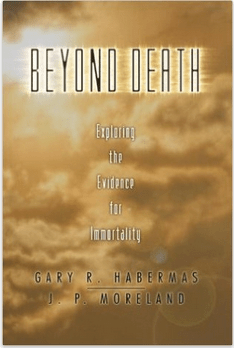
Beyond Death by Gary Habermas and J.P. Moreland

A review.

The Authors

Gary Habermas is Distinguished Professor and Chair of the Department of Philosophy and Theology at Liberty University. He is the author or coauthor of 12 books including The Case for the Resurrection of Jesus with Michael Licona, In Defense of Miracles with Douglas Geivett, and Forever Loved.

J.P. Moreland is Distinguished Professor of Philosophy at Talbot School of Theology, Biola University. He has authored or coauthored 16 books including Kingdom Triangle, The Lost Virtue of Happiness, and Scaling the Secular City. Both authors have dedicated their professional lives to making disciples by teaching them to think carefully about their faith, or in the words of one of Moreland’s titles, to “Love the Lord with all your mind.”

Synopsis

In Beyond Death, Habermas and Moreland examine several lines of argument and evidence for life after death, the Christian worldview, and the implications for this present life.

The book is divided into three sections. Part One lays out the case for immortality by offering reasons to believe in the existence of God, the case for substance dualism, the case for the resurrection of Jesus, and accounts of near-death experiences (NDEs.) Part Two explains the Biblical view of the intermediate state between death and the final resurrection, responds to the case for reincarnation, and describes Heaven and Hell. Part Three lays out the implications for these things for how we ought to live, face death, and the implications for bioethics with respect to edge-of-life issues.

Analysis

Beyond Death is a thorough treatment of questions concerning ultimate reality. Habermas and Moreland show how the evidence points to their conclusion without whitewashing things that don’t fall neatly into place. While they acknowledge NDEs in which the NDEr had a religious experience, they do not press these very far given the inability to verify the claims, as well as the inconsistency of them. Moreover, in their response to evidence of reincarnation, they are willing to explore explanations that some may not feel comfortable with.

Beyond Death is especially helpful in that while there are many books and articles making the case for the Christian worldview from philosophy and history, this book offers credible, contemporary experiential evidence. The book is accessible to the high school level reader. I recommend it for personal or group study.

Is It Possible That God Exists?

I was recently asked to “prove that it is even possible for God to exist.” In order to answer this challenge, we need to define some key terms. I will leave off “prove” for reasons that I think will become clear.

When I speak of God, I am referring to a being that is all knowing, all powerful, everywhere present, unchanging, good, rational, wise, and loving, and holds all these attributes perfectly and without limit. He is also self-existent, which means he is not in any way dependent on anything or anyone else for his existence, rather all else that exists is dependent on God.

With respect to time, I hold that he is timeless without creation, but temporal since creation. This is important to note in order to explain how it is more reasonable to think God is the one who brought the universe, all of matter, energy, space, and time, out of nothing. It is my view that time is simply the relation of before/after, duration and interval between events, where an event is a change in the state of affairs. On this view, there was a state of affairs where all that existed was God. God created the universe, and with it time. He has since sustained the universe for some length of time (it is beyond the scope of this post to argue for how long that has been.)

So how does this prove that God is possible? Now we have to define possible. Philosophers divide possibilities into three modalities: logical, metaphysical, and physical.

“…on the standard model of the relation between these kinds of modalities the logical possibilities are the most inclusive; they include any proposition that sheer logic leaves open, no matter how otherwise impossible it might be. The metaphysical possibilities are the logical possibilities that are also allowed by the natures of all of the things that could have existed. The physical possibilities are the logical and metaphysical possibilities that are also allowed by the physical laws of nature. [1]

So rather than “prove” it is possible that God exists, I need only show that his existence is consistent with at least one of the above modes of possibilities.

Is there any law of logic violated by God’s existence, or even the proposition “God exists?” It is not an identity statement, so there is no violation of the Law of Identity. There is no compound proposition from which an excluded middle could be suggested, so there is no violation of the Law of the Excluded Middle. And, since there is no claim that God exists and does not exist at the same time in the same sense, there is no violation of the Law of Noncontradiction. So in this case, asking for proof of logical possibility is really asking for proof of a negative, and really the burden should be on the one who thinks it is logically impossible since it would be so easy to meet it, but that’s just my opinion.

Is God’s existence metaphysically possible? Metaphysics is the study of things and what kind of things they are. In a sense it is the study of what is and what can be. It seems to me that a being with the attributes listed above is the kind of being that is among those things that could have existed. There is nothing about such a being that is incoherent. For this distinction, however, let me illustrate the difference between metaphysical and logical possibility. It is strictly logically possible that the Prime Minister is a prime number (there is no violation of the laws of logic.) However, since prime numbers are not the kind of things that by nature are Prime Ministers, it is not metaphysically possible. To say that God is the creator and sustainer of the universe is logically possible, and metaphysically possible since the kind of being God would be is the kind of being that could create and sustain the universe. Conversely, it is not metaphysically possible that God is the Flying Spaghetti Monster since the FSM is a material being and material beings are not the kind of things that can exist timelessly and unchanging.

With respect to physical possibility, there is nothing in the laws of nature that precludes the existence of God. This is a separate issue from whether it is possible to empirically detect God. How we can even in principle know God exists is a distinct issue from whether it is physically possible. It may even be fair to say that to ask the question of physical possibility is a category error since God is not a physical being. However, something is possible just in case there are no impossibilities against it.

So in all three modalities, it is possible that God exists. Ordinarily, I think whoever is making a claim bears the burden, and I have tried to support my claim that God’s existence is possible. However, it seems that taking a stance that it is impossible is to hold that the idea violates logic, or God cannot be the kind of thing that could have existed, or that there is a law of nature that precludes such existence. I would love to hear which of these is the case with respect to God.

[1] http://plato.stanford.edu/entries/modality-epistemology/#PriPos

What is Logic? “Baby, don’t hurt me…” Oops! Wrong Song

Argument From Logic to God

In a recent conversation, it was asserted that logic can exist all by itself and even “stands above God.” My interlocutor even suggested a logical version of the Euthyphro Dilemma whereby either things are logical because God says they are, and therefore could have been otherwise, or God says they are because they are logical, and therefore God is subject to logic, which would mean God is unnecessary to explain logic. This view fails for the same reason that the Euthyphro Dilemma in moral argumentation fails, because God is the ground of Logic, just as he is for morality. This solution was dismissed out of hand because it was somehow “illogical” for an eternal, self-existent being to exist. However, my friend seems to admit that logic is indispensible. He seems to think it can stand on its own. In order to resolve this, we need to look at just what logic is.

According to MirriamWebster.com:

Logic

: a proper or reasonable way of thinking about or understanding something

: a particular way of thinking about something

: the science that studies the formal processes used in thinking and reasoning

From dictionary.com

noun

  1. the science that investigates the principles governing correct or reliable inference.
  2. a particular method of reasoning or argumentation:
  3. the system or principles of reasoning applicable to any branch of knowledge or study.
  4. reason or sound judgment, as in utterances or actions:
  5. convincing forcefulness; inexorable truth or persuasiveness

From the Stamford Encyclopedia of Philosophy:

“Philosophically, logic is at least closely related to the study of correct reasoning. Reasoning is an epistemic, mental activity. So logic is at least closely allied with epistemology.”[1]

Finally, the Internet Encyclopedia of Philosophy says thus:

For the purposes of this entry, let us define logic as that field of inquiry which investigates how we reason correctly (and, by extension, how we reason incorrectly).  Aristotle does not believe that the purpose of logic is to prove that human beings can have knowledge.  (He dismisses excessive scepticism.)  The aim of logic is the elaboration of a coherent system that allows us to investigate, classify, and evaluate good and bad forms of reasoning.[2]

With the exception of source titles, italicized words denote mental activity, which is activity engaged in by a mind. The only way logic can exist is if there is a mind in which it operates.

Logic is not one of many possible conditions. It is a necessary reality in any world that exists. Keith Yandell writes, “Logic holds in all possible worlds. It applies to anything there possibly is, and hence to everything there actually is. To deny this is to embrace a self-contradictory claim.”[3]

Having laid this groundwork, l could lay out my argument in syllogistic form:[4]

  1. Logic is the structure of mental activity
  2. Mental activity is that which is engaged by a mind.
  3. Because logic holds necessarily, it must be grounded in a mind that exists necessarily.
  4. A mind must be had by a person.
  5. Human persons are contingent.
  6. A divine mind, if it exists, exists necessarily.
  7. On 3, if logic holds, a divine mind exists.
  8. If a divine mind exists, God exists.
  9. Logic holds, therefore God exists.

It might be objected that the only minds known to exist are human minds. However, this would beg the question, since such “knowledge” presupposes logic, which would have to exist prior to the arrival of the first humans.

Another issue that could be raised, “Then who made the divine mind?” This would be the same as asking, “Who made God?” However this would be a category error since the God posited by classical theists is, by definition, self-existent. Moreover, such a question raises the issue of an infinite regress. If you say some agent made God, you could ask who made that agent, ad infinitum. However, in his work on the Kalam Cosmological Argument, Craig shows that an actual infinite number of things cannot exist in the world (such as an infinite number of moments in time.) Moreover, even if it were possible, you could not accumulate an infinite number of things, like seconds, weeks, years, etc by successive addition.[5]

Ultimately, since logic is a related to mental activity, it is not possible for it to hold if no minds exist. Moreover, it is not a defect on God’s part if he cannot violate the laws of logic any more than it is a defect that he cannot do evil. This is a perfection, not a defect. That he cannot violate logic just means he cannot err in his thinking. Likewise, that he cannot do evil means he cannot fail to be perfectly good. All this is to say that God cannot fail to be God.

Logic holds in all possible worlds. Logic is mental activity. Mental activities are activities of a mind. Logic must be grounded in the mind of a necessary person. Humans are contingent. Only divine minds can exist necessarily. Therefore, logic is grounded in a divine mind, therefore God exists.

[1] http://plato.stanford.edu/entries/logic-classical/#1

[2] http://www.iep.utm.edu/aris-log/, “Laws of Thought”

[3] Yandell, Keith E. (2002-01-22). Philosophy of Religion: A Contemporary Introduction (Routledge Contemporary Introductions to Philosophy) (p. 70). Taylor and Francis. Kindle Edition.

[5] An article that goes into more detail on this can be found at http://www.reasonablefaith.org/forming-an-actual-infinite-by-successive-addition

Is Faith “Belief Without Evidence?”

In a recent conversation, a skeptic told me faith meant belief without evidence. He dismisses explanations that Biblical faith is grounded in reasons and evidence and cited the fact that so many people believe without being able to articulate the reasons or point to the evidence. He is a fan of Peter Boghosian, Professor of Philosophy at Oregon State University and author of A Manual For Creating Atheists, who popularized this definition.

While such a definition may seem plausible to them, since many religious believers including Christians are unprepared to make a rational defense of their faith, is it really the case that they are believing without evidence? It should be noted at this point that evidence never speaks for itself. Evidence is one thing, and interpretation or explanation is another.

Some Christians grew up in a Christian home. They learned the Christian faith from their parents. Their parents told them many things that turned out to be true. So, when they told them about Jesus, they believed it. Did they have evidence or reasons? As far as they were concerned, they were getting their information from a trusted source. They had reason to trust their parents. That counts as evidence.

Some grow up with no religious teaching, but when they hear the Gospel from a friend, or in a church service they attend with a friend, they respond to an internal sense of the truth of the message. Is this evidence? I think it counts as a religious experience. Religious experiences count as evidence.

Still others attend a church service or evangelistic meeting where an evangelist uses scare tactics to manipulate the audience. Some respond to the fear they feel, sensing it to be evidence of the truth of the message.

Others respond to the message from friends whom they knew before they had become Christians and saw how their lives had changed. They saw this change as evidence for the truth of the Gospel.

In each of the examples above I have shown that believers who may or may not be able to articulate reasons why the Gospel is true believed with evidence. A skeptic may find the evidence in each case unconvincing, and think the believers naive for putting their faith in someone on such bases. That is his choice. However, in every case there was evidence, which the individuals took to be persuasive. Ultimately, defining faith as “belief without evidence” is just another dismissal. If the skeptic was brutally honest, he would say Biblical faith is believing without evidence that would persuade him.

Questioning Islam by Peter Townsend: a Review

I typically begin my reviews with some information about the author and his qualifications and interests in writing his book. In the case of Peter Townsend, I could find nothing. It could be because it is a pseudonym, which given the subject matter of this work, may be a wise thing. It is hard to issue a fatwa against someone if you don’t know who he or she is. Since I do not read or write Arabic, I am in no position to evaluate his research, but everything he says in Questioning Islam is consistent with everything else I have read from known sources, so I have no reason to doubt his conclusions.

After defending the book itself, Townsend anticipates objections that can arise from his arguments and offers a brief sketch of Islam’s history and teachings. What then follows is a detailed critique of the origin, teachings, and practices of Islam, using highly respected Islamic sources for each, as well as noting the lack of archaeological evidence for the city of Mecca before the formation of Islam.

Townsend notes the interesting absence within the Qur’an itself of the Five Pillars of Islam (these are found in the ahadith,) but a plethora of what seem to be very convenient “revelations” that seem to serve Mohammed well in his circumstances. He also offers rebuttals to claims of originality, citing many earlier sources that contain texts very close to several suras, as well as the gap of at least 200 years between the death of Mohammed and the earliest trusted hadith. Finally, Townsend critiques many Islamic teachings in light of modern sensibilities.

Townsend never states what his religious views are in this book. His stated purpose is to encourage Muslims to examine their beliefs and the reasons they have for holding them. However, while demolishing Islamic teaching, he offers no alternative. This comes in stark contrast to works by authors such as Nabeel Qurreshi, who encourages building relationships with Muslims and earning their trust before offering such comments. As a Christian, I would recommend this book as an informational resource for Christians reaching out to Muslims, but not as a model for that outreach. Townsend’s tone is a little triumphalist when he presents damning evidence against the claims of Islamic texts. Moreover, Townsend’s critique of some teaching is based on how they compare to modern sensibilities. However, this tells us nothing about whether or not they are true. There are Christian teachings, which I think are true that could also be said to be “out of touch…” It is hard to imagine expecting a Muslim to read Questioning Islam and coming away with a willingness to engage in a dialogue. As an apologist, if I offer a critique of a person’s beliefs that seem to be false, it is for the purpose of offering them a true alternative that will actually be good for them to embrace. Moreover, it only makes sense that if you are going to try to persuade someone to abandon beliefs they hold dear, you need to be very sensitive in your approach. Townsend seems to take a little too much satisfaction in finding the problems in Islam. Moreover, to emulate this tone leaves little possibility that the Muslim will be open to whatever alternative I have to offer.

The Challenge of Islam: Does Early Testimony Matter to Muslims?

A great post by Eric Chabot

chab123's avatarTHINKAPOLOGETICS.COM

Just this past week I had the opportunity to speak to some Muslims about one of the largest differences in our faith and their faith. For Christians, the death and resurrection is central to the Gospel message. After all, the “Kerygma” in the Book of Acts is the Messiah was crucified according to the plan of God (Acts 2:23) and that He was raised from the dead and appeared to his disciples (Acts 2:24; 31-32; 3:15-26;10:40-41;17:31;26:23). But for Muslims, they think Jesus didn’t die. Instead, the early disciples were deceived and Allah delivered Jesus. It says in Sura 4:156-157:

“And [for] their saying, “Indeed, we have killed the Messiah, Jesus, the son of Mary, the messenger of Allah .” And they did not kill him, nor did they crucify him; but [another] was made to resemble him to them. And indeed, those who differ over it are in doubt about it. They have…

View original post 1,635 more words

Doubting Toward Faith By Bobby Conway: A review

Bobby Conway is a lead pastor of LIFE Fellowship, Charlotte, and the One Minute Apologist on YouTube. No stranger to seasons of doubt in his own life, Conway brings his experience, Biblical teaching, and careful thinking to the issue of dealing with doubt.

Through ten chapters, Conway explains the effects of doubt on the mind, the church, and one’s faith, the universality of doubt, and the hazards related to leaving them unexamined. Moreover, even when none of our friends can deal with our doubts, Jesus can.

Conway explains how doubts arise, some of the most common types, and the roots. Then he shows how to work through it, especially noting how faith is grounded in reason, not credulity.

Conway spends a lot of ink describing the experience of doubt, and at first this struck me as filler. However, having read it, it occurs to me that he has done a masterful job of helping the reader who has not recently dealt with serious doubt feel the weight of the experience. Moreover, for the reader who is struggling, or has done so recently, Conway’s description helps them see that he is not approaching this from a cold, academic point of view.

Doubting Toward Faith is a must-read for anyone plagued by doubts in their Christian faith, but even better to read it without waiting for the doubts to come. How much better to be ready beforehand?

This book is suitable for readers from high school students to college professors. It would also make an excellent resource for small group study.

Lioness of Planned Parenthood Guards Pride, Not Cubs

An excellent analysis by my friend Grant Bresett

Grant Bresett's avatarThe Apologers

Planned Parenthood logoThe Lioness is a symbol of strength – more specifically, feminine strength. That strength is usually found in the ferocity used to protect her young.

With Planned Parenthood, the young are the ones in danger because of the lioness.

The first five videos reveal Planned Parenthood profiting from selling aborted body parts (videos 1-4video 5). In this sixth video, Holly O’Donnell, Ex-Procurement Technician with StemExpress LLC,  heaps more testimony onto the pile of evidence against Planned Parenthood.

The latest video uncovers Planned Parenthood’s blatant disregard for women.

This goes to the heart of pro-abortion arguments. They sell themselves as champions of women’s health and women’s rights. This video shows Planned Parenthood exploit women for fetal body parts and financial gain.

Those who’ve been following Planned Parenthood are not surprised. These videos, however, make it accessible for everyone to see.

The Coercion

“She told me, she’s like, it’s not an option. It’s a demand…

View original post 483 more words

Connecticut Bluegrass Association

“The Connecticut Bluegrass Association — or CTBA — is dedicated to bringing together the bluegrass community in CT, promoting Bluegrass Bands, Education, Jams, festivals, and event Venues.”

Think Divinely

How you think changes everything

Theology in Motion

Knowing God Should Move You

Amanda Casanova

Writing about running, faith, and the trouble my two dogs get into

Quodlibetal Blog

Musings from Anywhere by Dr. Richard G. Howe

31 Days of Prayer

A month-long call to prayer and fasting

Bible Backgrounds

Research and Commentary from Dr. Craig Keener

Boon4You

If You Disagree With Me...You're Probably Wrong.