How Not to Look Stupid on Social Media

“Can you believe that church has a waterslide baptismal?

“The NFL is going to ban the National Anthem before football games!”

“Copy and paste the following if you don’t want your pictures and posts used for advertising…”

“Like this post and Facebook will donate money to…”

“The atheist professor dared God to stop a piece of chalk from breaking…”

Einstein humiliated an atheist professor…”


Many Christians see things on the internet that either enrage or excite them. They then often post or share them on social media. Unfortunately, they rarely fact-check the stories they share or react to. The result is that Christians look naïve, reactionary, and foolish.

I like a rule I learned from Greg Koukl: “Never read a Bible verse.” In other words, never read a verse in isolation. However, I think one verse, though out of context, contains a principle that it would be wise to apply more generally: “examine everything carefully; hold fast to that which is good.” The first item above is actually referring to a story posted on a satire website, the Babylon Bee. The folks at the Babylon Bee post hilarious parodies of the Christian subculture. But they are writing satire, not news. It is important that when you see a story that gets you riled up, check the source. If you follow a link to a website and you are not sure, look for a link that says “about” or something like that. At the bottom of every page on the Babylon Bee, you can see “The Babylon Bee is Your Trusted Source For Christian News Satire.” A list of satire sites from around the world can be found here.

As for the rest of the items above, a simple look at websites like snopes.com. or factcheck.org will save you from looking stupid when you share the latest internet myth.


As Christians, we are called to be salt and light. We are to display the “peaceful fruit of righteousness” (Hebrews 12:11) not to look like religious nuts.


.

Podcasts You Should Know Part 3

One of my favorite podcasts for its entertainment value (that also has all the substantive things I like in a podcast) is the Phil Vischer Podcast. If you grew up (or raised children) in the 90’s, you’re probably familiar with Vischer’s work from watching Veggie Tales. In his podcast, Vischer is joined by Christian Taylor and Skye Jethani in a panel discussion format. The issues they deal with could be categorized as cultural apologetics.

Some of the comments, particularly from Jethani, but Vischer as well, can seem provocative on the face of it. However, if you carefully consider what they have to say, even if you don’t agree with them completely, they often have a point. They are not shy about calling out the “crazy uncles” of American Christianity.

As long as we’re talking about Vischer’s work, another project worth noting (free plug here) is “What’s In the Bible,” *DING!* a DVD series which presents a survey of the entire Bible using puppetry. Vischer does all the puppetry and all the voices for the characters. It is not a dumbed-down, cutesy Sunday School curriculum.  It has great information from which adults can benefit, and it is entertaining for kids and grown-ups. (If you listen to the podcast, you will get the “DING” reference.)

The podcast is free, but if you like the work Vischer does, then you can support him here.

Enoch Primordial by Brian Godawa: a Review

Brian Godawa is an accomplished screenwriter and author. In addition to books on film and worldview, and the role of mythology, he has written several series of novels in the fantasy genre. One such series is The Chronicles of the Nephilim. Enoch Primordial is the second of this series.

Like the rest of the series, Enoch Primordial combines the biblical narratives of Genesis with apocryphal and pseudoepigrahic literature (non-canonical ancient Near Eastern documents) along with his fertile imagination to craft a compelling story that fills the gaps in the biblical narrative in a creative way. Godawa makes no claims that these events actually occurred. Rather, the story is a vehicle for communicating his worldview.

Some of my favorite parts include the pathos of Adam and Eve living hundreds of years with a memory of the close fellowship they once had with God. (That’s a long time to live with regret.) There is also the incorporation of the words of contemporary political figures in the mouths of villains. This may make some uncomfortable, as though Godawa was demonizing his political opponents. However, on the Christian worldview, our enemies are not human. If the ideas of our opponents are evil, it is right to attribute a spiritual source.

Enoch Primordial is an entertaining, enlightening read.

When a Good Church Goes Bad by Casey Sabella: A Review

Casey Sabella has been a pastor for over 40 years, currently serving as pastor of Motion Church. I have known him personally for about 25 of those. Having served as long as he has in leadership positions, he has an insider’s perspective that lends a poignant quality to this work.

When a Good Church Goes Bad is a case study of how trust can be abused. In this his second edition, Sabella adds what he has learned in the years since his experience how his own life experience beforehand contributed to his involvement with a church that went bad, and how he participated in that fall.

The book is arranged in twelve chapters, starting with Sabella’s own testimony of coming to faith. In the chapters that follow, Sabella charts the rise and fall of the church, including insights into the character of the pastor, Sabella’s own contribution to its rise and fall, as well as realization of how his background and upbringing set the stage for these events.

It is easy to think from the title that this is some kind of exposé on a church complete with salacious details. In fact, this is a cautionary tale of how our own baggage, combined with the absence of accountability, can lead to disaster. An important takeaway is, if my church has problems, I may well be part of the problem.

Casey Sabella handles this difficult issue with a good balance of honest introspection and critical analysis of leadership structures and practices. This book is a must-read.

Podcasts You Should Know About Part 2

This week I want to call your attention to not just a podcast, but another ministry that has more than one fine podcast. Reasonable Faith, the ministry of Dr. William Lane Craig, is a highly useful resource, including two podcasts: Reasonable Faith, and Defenders. Reasonable Faith is a weekly podcast hosted by Craig and Kevin Harris where they discuss recent events and debates related to Christianity and apologetics. Defenders is a weekly class taught by Craig that is accessible, yet thorough in its systematic treatment of Christian doctrine. Defenders is available as a podcast, but also can be accessed as a live stream on Sundays at 12:45 Eastern time. In addition to the podcasts, the Reasonable Faith website has a wealth of information related to apologetics, as well as philosophy. There is a whole library of videos of Craig’s teaching and debates.

Podcasts You Should Know About Part 1

Over the next several posts, I will highlight some really useful resources for Christians. Obviously, being the geek that I am, the emphasis will be on apologetics resources, but many of the websites and podcasts I will profile have a broad range of information for any Christian interested in growing in the area of the life of the mind.


Unlike other “Top…” lists, I will start with what I think is the number one ministry in this field, and the rest will be in no particular order. Far an away my favorite (and arguably the best) is Stand to Reason. Greg Koukl has been like a long-distance (and occasionally up close) mentor to me since around 2000. He has had a radio presence for over 20 years, and the show has been available online since before there were podcasts. It is still available as a live stream on Tuesday evenings from 4-6:00 pm PDT (7-9 EDT) or the show can be downloaded as two one-hour podcasts on Wednesday and Friday. There is also a shorter podcast released twice a week called #STR Ask.

Additionally, he offers a wide range of resources from books (two of which he has written or co-written) as well as short booklets, called Ambassadors’ Guides, which are available in paper or electronic editions. STR also offers instructional DVDs like Tactics. These resources and podcasts can also be accessed through their mobile apps.

Finally, Greg and his team are available to speak to your church or ministry. More content can be found on their blog, as well as the bimonthly newsletters, such as Solid Ground.


STR is a valuable resource to help Christians think more carefully about and communicate their faith.


Meaningful World By Benjamin Walker and Jonathan Witt: A Review

With a Ph.D. in Theological Ethics, Benjamin Wiker lends his expertise along with the literary insights of Jonathan Witt, Senior Fellow for Discovery Institute’s Center for Science and Culture, to the question of just what kind of world we live in. Wiker and Witt do not simply disagree with the reigning paradigm of metaphysical naturalism found in science. They see it as harmful. They have written this book as an antidote to the “poison” that is “the assumption that science has proven that the universe is without purpose, without meaning—proven it so clearly that one need not even produce an argument.” (Wiker and Witt, Location 61.)

The question of meaning has implications for how all of reality is seen. For Christians concerned with preaching the gospel, juxtaposing a divine creator with a meaningless universe is incoherent. This is one of the reasons why the apologetic project is needed in order to make Christianity a live option in the marketplace of ideas. In this particular case, the meaningfulness of the universe needs to be recognized. The poison must be counteracted. Recognizing the fact that human beings are an integral part of the universe, and that we have lived, acted, and created as though the world has meaning, Wiker adds his analysis of the works of Shakespeare which are best understood if meaning were central to human understanding of the world, as well as a comparative analogy to the creativity found in nature.

“The book’s central claim is clearly stated: the universe is meaning-full.” (63) The authors make it plain that they reject the nihilistic paradigm that is claimed to be “proven” by science. They build their case beginning with a historical overview of how the idea of a random, meaningless world goes back to the ancient Greeks and found resurgence in Darwin, Nietzsche, Freud and Marx. The assumption of meaninglessness began to lose momentum as discoveries of order and specified complexity began to emerge such that even a hardened skeptic like Antony Flew was moved to theism. From this background, Wiker and Witt note that just as parts of the cosmos made sense in light of the whole, and perhaps only so, the same is clearly so in literature. Shakespeare’s works are examined to illustrate the point, showing that contrary to Dawkins’ illustration of “Methinks it like a Weasel,” the parts fit the whole, but also that the whole makes no sense if the works and their author are nothing more than matter in motion, or animals driven by the urge to procreate. The genius exhibited by Shakespeare is then used to illustrate the genius Euclid points to in mathematics. The authors show how on a materialist worldview, the existence of mathematics makes no sense, much less its applicability to the material universe. From mathematics, the order and intelligibility of the cosmos, chemistry (especially the periodic table) and biology is examined. Through each discipline, the antidote of structuralism is counteracting the poison of reductionism. Structuralism approaches these questions from the top-down, parts-to-whole view. Such a view is not even considered a live option if one starts from meaninglessness. In fact, it is the only way scientists can discern “the meaning of the data they gather.” Wiker and Witt present case after interrelated case for the meaningful whole of the created order into which each of its parts –matter, energy, chemistry, life in general, and humanity in particular– fits. While so many books of this type focus on particular arguments for God’s existence from specific areas such as cosmogony, fine-tuning, or information theory, Meaningful World looks at the big picture. If the other works study the trees, Wiker and Witt look at the whole forest. They show not only that these things fit, but also that they are made to be discovered as such. They do so with a clear, accessible style and a refreshing dose of humor. While their arguments are logically cogent, their discussion of Shakespeare’s literary acumen appeals to aesthetics. Moreover, while they mention some of the astronomically high levels of improbability of the world being the way it is by chance, they do not hang their whole case there. Another way the thesis of the book can be stated is, “Intelligent design? More like creative genius.”

The literary element they introduce by way of analogy and as a particular example is a rarity in books on this subject. Their use of Shakespeare to illustrate their point is not only a novel way to argue in this arena, but they inspire a new appreciation for the literature itself. Their presentation reaches the reader at the cognitive as well as the intuitive level. Moreover, they present a strong case in favor of their thesis, rather than simply relying on defeaters for its negation. They do more than show that reductionism is false. They present a powerful case for a meaningful world. More than merely meaningful, the authors offer a case for elements of genius in the created order that is analogous to the creative genius of Shakespeare. Wiker and Witt argue that the knowledge offered by the study of mathematics, cosmology, chemistry and biology have the depth, clarity, harmony and elegance one would expect to find in the works of geniuses. This is not design by a minimally intelligent mind, but a designing Genius.

This book is a must-read for anyone interested in the philosophy of science, or the history of the controversy over the Intelligent Design hypothesis. The book is accessible to the layperson without dumbing down the content. While the scholarship of the authors is evident in the content, the engaging style of the prose has none of the dryness that can come from the subject matter. The integrated approach will inform a more fully orbed apologetic than those books that focus on a narrower topic such as the origin of information or the complexity of the living cell. As important as these details are, this book will help you see the forest and the trees.

I Read How To Be an Atheist, and Now I Believe In Moral Subjectivism


Mitch Stokes is a Senior Fellow of Philosophy at New St. Andrews College in Moscow, Idaho.  He received his Ph.D. in philosophy from Notre Dame under the direction of Alvin Plantinga and Peter van Inwagen.  At Yale, he earned an M.A. in religion under the direction of Nicholas Wolterstorff.[1] In fact, being trained by Plantinga, van Inwagen and Wolterstorff made J.P. Moreland positively gush at Stokes’ credentials. That is high praise indeed. Stokes is the author of A Shot of Faith (to the Head): Be a Confident Believer in an Age of Cranky Atheists, and the current book under review, How to Be an Atheist: Why Many Skeptics Aren’t Skeptical Enough.

Many militant atheists pride themselves on their reliance on reason and science to tell them the truth about the world. They are especially confident of their views of science and what it can tell us about morality. Stokes argues that if they were to put their skepticism where their mouths are, they would be a little more hesitant to assert that science has proven that naturalism is true (and therefore theism false) and that morality is real.

How to Be an Atheist is a short book of just over 200 pages, broken into three parts. In part one Stokes shows the problem of relying on reason and science as articulated by one of the “heroes” of the Enlightenment, David Hume. In part two, science is examined to see the limits of what it can tell us, especially with respect to what is unobservable. This section includes a helpful explanation of how theories, which are neither easily dismissed claims nor iron-clad laws, are inferences that try to make sense of what has been observed. (Stokes also holds advanced degrees in engineering, so there is no anti-science bias here.) Also noted is the fact that many of the areas of physics most often cited as evidence for naturalism are instrumental rather than realistic, which is to say, the theories involving quantum mechanics and such are models used to make sense of what can be observed, but do not even claim to accurately describe what cannot be observed. In the third section, Stokes argues that if naturalism is true, then morality, actual good, bad, right and wrong, does not exist. They are merely expressions of human likes and dislikes.

It is this third section that prompted the title of this review. Stokes argues that all values are personal. The thing that makes something good (in a moral sense) is a value holder. Likewise, a duty or obligation is only held between persons. Many atheists would affirm this. However, this is not to say that morality is ultimately grounded in human persons. After all, if all morality is mere human preference, which human? Why this one and not that one? Why yours and not mine? It is not hard to see why this can lead right back to a kind of moral anarchy. As Stokes notes, Christianity has held to what is called “Divine Command” theory of ethics which is the idea that which is good, and that which we are obliged to do and prohibited from doing, is good, obligatory, or prohibited because God has commanded it. He further notes that the common “Euthyphro objection” is resolved when we understand that God commands what he does because his nature is good.

All this is not to say that morality is relative. Moral standards are person centered (or on Stokes’ view, Person centered.) Whatever the standard, whether a behavior measures up is an objective reality. However, it is not the behaviors themselves that are intrinsically good or bad, but these values are derived from the Value Holder, God himself.


Stokes’ book is highly accessible, well reasoned, and fun to read. Stokes has a flare for mixing humor into a technical subject. He is generous in his treatment of those with whom he disagrees, and sets quite the example in this. I highly recommend this book.


[1] CV taken from http://www.mitchstokes.com/about.html

Mining For God: a Review and Response

Last July, I was contacted by Brandon McGuire telling me about his new film. I ordered a copy and watched it to see how good a resource it would be for my Ratio Christi chapter or any other apologetics classes I teach. The problem I had when I watched it is that having recently completed a Masters Degree in Christian Apologetics, the material in the movie was too familiar. I wasn’t sure if it was too technical for a lay audience, or interesting enough. (Even your favorite song gets old after a while.) So I asked one of my Sunday School students to watch it with her family and let me know if it was helpful. She and her husband have several unbelieving children and relatives whom they invited to see it as well. Her nephew, an atheist, wrote the following review. I thought it was so even-handed and well written that I would share it here, with a few comments at the end.


“MINING FOR GOD” Documentary Review by John Regina


While being the first documentary of this sort that I have watched (at least in recent years), I found myself quite familiar with a good portion of the information and opinions presented, in particular the apologetics that were interspersed throughout. I rather enjoyed the seemingly random interviews conducted in public with (“non-expert”) Americans mainly during the first ten minutes of the film, and in relatively short order was under the impression that one of the film’s primary objectives is an attempt to clarify what it means to be a practicing Christian, as opposed to the many Americans that select their religious and/or spiritual beliefs a la carte (the term “cafeteria style” is used in the film) or have a misapprehension or otherwise vague interpretation of Christianity. I would have liked to see more of these interviews, or at least a more thorough investigation of the “70%” of Americans cited by the film that identify as being Christian.

Directly following the interviews the film’s narrative veers sharply into apologetics, sometimes for the better and other times not. I would consider the information presented in the film to be an entry-level, beginners’ introduction to Christian apologetics, because it covers much ground, including a cursory (although not detailed nor expansive) examination of most of the core claims that I am aware of. I felt that some arguments, as with some of the commentators, were more convincing than others. For instance, I felt that the ‘cosmological, “first cause” argument’ (for God) was summarized brilliantly, mainly by William Lane Craig- although he failed to address the opposing problem of  “infinite regression” often cited by skeptics. However, I did not like the manner in which the “teleological argument (or hypothesis of intelligent design)” was presented, due to the Creationist/anti-evolution viewpoint that was briefly expounded upon (by the commentator Donald Williams). I feel that the “argument from morality” was perhaps the strongest, most persuasive argument for the existence of God that was presented, but am also of the opinion that too much time was devoted to the sub-topic of personal sin. Lastly, I found the viewpoints expressed within a couple parts of the film relating to pluralism to be intolerant and at odds with American culture. After all, our country was primarily founded on secular values, and however Christian our nation may be, we should hold firm to our established right to religious freedom, even in rhetoric.  Overall I found the film to be informative, well put together and great as an introduction to apologetics.


Response

I really appreciate the tone of this review. I would just like to respond to a few things the author says. In response to the cosmological argument, Regina says “… he failed to address the opposing problem of  “infinite regression” often cited by skeptics.” Note that in the argument from first cause, the first premise is “Whatever begins to exist has a cause.” God, by definition, never “begins” to exist. For God to begin to exist, he would have to have a cause, which is greater than him. However, if there were anything greater than God, than IT would be God. As Regina noted, the film is a beginners introduction to apologetics. The discussion on the impossibility of actual infinites can be technical, and making it accessible would be lengthy. I discussion of this can be found here.

Regina thought too much of the discussion of the moral argument focused on personal sin. But the whole point of noting the existence of objective morality is that personal sin is a real problem, for which Christ is a real solution.

Finally, Regina seems to conflate the ideas of religious pluralism with civic pluralism. Religious pluralism is the claim that all religions are equally true and valid. However, logically the only way this could be true is if they are all false, since they make contradictory truth claims. Christianity claims to accurately describe reality. If it does, then religions that contradict Christianity are necessarily false inasmuch as they contradict it. Likewise, if any religion that contradicts Christianity accurately describes reality, then Christianity is false. Civic pluralism, on the other hand, is the view that each citizen has the right to believe what he wants without fear of government interference. Christianity is only “intolerant” in the way the word has been redefined to mean disagreement. That it is at odds with American culture, well so what? As for religious freedom, that too is a Christian idea. We share the Gospel with people. We do not try to force it on them. As to the “secular” values that America was founded on, even letting the claim pass, the values America was founded upon result from the impact Christianity has had on Western Civilization. More on that can be found in Glenn Sunshine’s fine book Why You Think the Way You Do, a review of which can be found here.

Once again I want to say how much I appreciate the thought Regina put into his review. Too often reviews of films like this from an opposing view tend to come from trolls. (I know, we have our share too.)

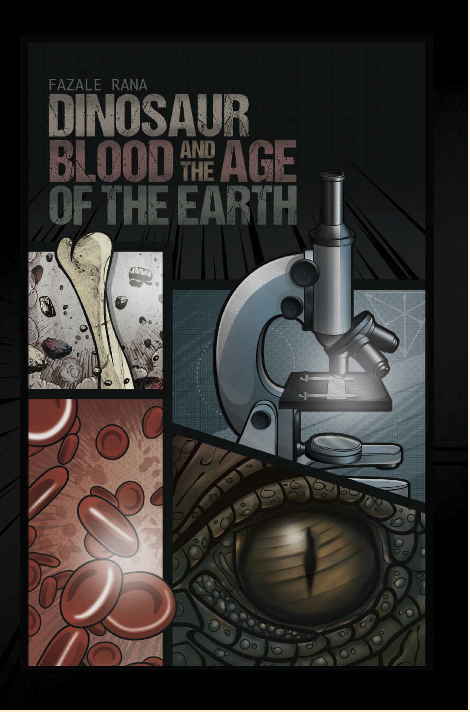
Dinosaur Blood and the Age of the Earth by Fazale Rana: a Review


Fazale Rana is the Vice President of Research and Apologetics at Reasons to Believe, a science-faith thinktank in Covina, CA. Rana earned his PhD in Chemistry (with an emphasis on biochemistry) at Ohio University. He is the author of The Cell’s Design, Creating Life in the Lab, and co-author of Origins of Life with Hugh Ross, in addition to the book under review.

In 2005 a team of paleontologists led by Mary Schweitzer discovered 70 million year old fossilized dinosaur eggs that contained soft tissue. This controversial discovery has led to mixed reactions from the scientific community, since it has long been thought that no such tissue could survive such long periods of time. There are skeptics who think the discoveries reflect contamination, and therefore not tissue that was original to the fossilized organisms. There are those who accept the findings on their merits and are seeking to make sense of how it could happen. Another group are Young Earth Creationists (YECs) who accept the findings and see them as evidence that radiometric dating methods are unreliable when they date the fossils as older than a few thousand years. Rana offers arguments that the findings could be genuine and that they in no way prove radiometric dating to be unreliable.

Dinosaur Blood and the Age of the Earth is just four chapters long. In the first chapter, Rana catalogs some of the soft tissue discoveries in the fossil record. In chapter two, Rana cites the best work put forth by YEC researchers seeking to show how soft tissue is best explained by a young earth. In chapter three, Rana notes the problems with the arguments against radiometric dating, explaining how it is done and why it is trustworthy. In chapter four, Rana explains a number of mechanisms by which soft tissue could be preserved over long time periods. In his conclusion, Rana encourages readers to consider all the evidence before making a judgment.

Three appendices follow the core content, with a defense of the Day-Age interpretation of Genesis, which Rana holds to along with Hugh Ross, as well as addressing the science fiction of the Jurassic Park movie franchise, and the work done on reverse engineering and estimates of dinosaur genomes.

The discovery of soft tissue remnants (and make no mistake, these are remnants, not large chunks of meat) has been the “go-to” for many people in the YEC community when they argue for a young earth. Rana’s work shows how weak this argument is. Moreover, Rana’s explanation of radiometric dating techniques is very helpful in seeing how easy it is to misuse them to defend a point of view. While the jury is still out on whether these are genuine soft tissue remnants, or if there is a better explanation, Rana thoroughly defends their plausibility. These scientific issues and their theological implications are areas where Rana excels.

With respect to Rana’s defense of the Day/Age view of Genesis 1, I especially appreciate Rana’s humility in his presentation. I was personally first convinced that the 24 Hour view held by YECs was false by the Reasons to Believe Scholar team. However, I don’t find the Day/Age view compelling. The repetitive structure of Genesis 1 strongly suggests something other than plain historical narrative. For a highly plausible alternative, called the Analogical Days view, can be found here in a commentary by C. John Collins. I have noted here my disagreement with the strong concordism of RTB scientists’ approach. Another weakness I see to the argument is, “There are a number of passages throughout the Old and New Testaments that make direct statements about the antiquity of the earth and its features.” (Kindle Location 1248) These passages use words like “long ago,” “ancient,” etc to describe these features. While I am not a YEC, I could easily imagine one saying, “So what? A 16-year-old thinks a 30-year-old is ancient. Why wouldn’t the Bible writers think a thousands of years old planet was ancient?”

Rana gets a little technical in his explanations of the science, but it does not require an advanced degree in science to get the gist of his case. He makes a compelling case for the plausibility of the discoveries, as well as a solid refutation of the claims YECs make about their implications. I highly recommend this book to anyone interested in these issues.


Connecticut Bluegrass Association

“The Connecticut Bluegrass Association — or CTBA — is dedicated to bringing together the bluegrass community in CT, promoting Bluegrass Bands, Education, Jams, festivals, and event Venues.”

Think Divinely

How you think changes everything

Theology in Motion

Knowing God Should Move You

Amanda Casanova

Writing about running, faith, and the trouble my two dogs get into

Quodlibetal Blog

Musings from Anywhere by Dr. Richard G. Howe

31 Days of Prayer

A month-long call to prayer and fasting

Bible Backgrounds

Research and Commentary from Dr. Craig Keener

Boon4You

If You Disagree With Me...You're Probably Wrong.