So Now I’m a Christian. Now What? Part 5: The Incarnation

“Incarnation? What do flowers have to do with anything?”

Not, carnation, incarnation. It means God took on flesh in Jesus Christ. We read in John 1:

“In the beginning was the Word, and the Word was with God, and the Word was God. He was with God in the beginning.  Through him all things were made; without him nothing was made that has been made… The Word became flesh and made his dwelling among us.” (Verses 1-3, 14)

It is clear from verses 1-3 that “the Word” is God. In verse 14 we are told he became a man. This is not to say that God changed from being God to being a man. Rather, God added to himself a human nature.

You will remember that in part 1 I said God does not change.

“Really? You don’t think “becoming a man” is a change?”

When I explained the difference between “essential” attributes and “accidental” attributes, you will note that “not having a human nature” was not an essential property. God did not have to take on flesh. Moreover, none of his attributes changed. If they did, it would have been called an “intrinsic” change. That means a change in his nature or being. Adding to himself a human nature, or more precisely, the second Person of the Trinity adding to himself a human nature did not change the nature of the second Person. He is still divine, still omnipresent, omniscient, omnipotent, etc. Adding to himself a human nature is what is called an “extrinsic change.”

In order to make sense of what it means for the divine Person to “add to himself a human nature,” we need to unpack what a human nature is.

A human being is a body/soul unity. This means you are a soul and you have a body. I know some people think we are a body, soul and spirit. For our purposes here, we will leave aside that debate. Suffice it to say we are made of two substances; a material body, and an immaterial soul. (If our spirit is a third part, it is still immaterial, so the debate is not relevant for this point.)

“What do you mean ‘immaterial?’ Like it doesn’t matter?”

No, by immaterial, I mean non-material. In other words, our soul has no weight, mass, and does not extend in space. It cannot be detected with the five senses. It is not made of physical matter or energy. Included in our soul would be things like the mind, the will, emotions, and personality. Our person-ness is in our soul. Moreover, there is good reason to think the soul directs the physical development.

“Isn’t the mind just the brain?”

No. It is beyond the scope of this essay to explain. The brain is part of the body, and is the primary interface between the soul and the body (except for development, and possibly another aspect which will take us too far down a rabbit trail to explain now.)

As human persons, our consciousnesses, our thoughts and feelings, are informed from two sources; our bodies and our souls. For example, when our bodies need energy, our brain tells us we are hungry. If we eat a cheeseburger, our brain then tells us we are not hungry. However, there is another aspect of this process that is not physical. Two people can get hungry and eat a cheeseburger. One really likes cheeseburgers and therefore, enjoys his meal. The other may find he hates cheeseburgers and vows never to eat one again. In both cases, there reaction was emotional. To put it another way, souls cannot chew cheeseburgers and bodies cannot enjoy them.

“What does all this have to do with Jesus?”

Glad you asked. Remember I said that in Jesus Christ, the second Person of the Trinity took on a human nature. That means he added to himself a human body and a human soul. There is one very important difference, however. You will note I said, “Our person-ness is in our soul.” In Jesus, this is not the case. Jesus is just one person, or Person. His human soul had its “person-ness” by being in union with the second Person of the Trinity. Moreover, Jesus’ consciousness has three sources, rather than two. As the second Person of the Trinity, he shares an intellect, will, and emotions with the Father and the Holy Spirit. There is one divine Mind, Will and Emotions. So his consciousness is informed by the divine mind, will, and emotions. Also, it is informed by his human mind, will, and emotions. Finally, his consciousness is informed by his body.

“But when they asked Jesus when he would come back he said, ‘But about that day or hour no one knows, not even the angels in heaven, nor the Son, but only the Father.’”

As a divine Person, he would choose what to reveal to his human consciousness. The second Person of the Trinity is only referred to as “Son” in and since the incarnation. Understanding this union of God and flesh also makes sense of what Jesus meant when he prayed, “…not my will, but yours be done.” God only has one will. However, Jesus had a human will as well.

I realize this post could get technical. Please feel free to post questions about anything here you don’t understand. In my next post I will explain why all this was necessary.
Part 5: The Incarnation


“Incarnation? What do flowers have to do with anything?”

Not, carnation, incarnation. It means God took on flesh in Jesus Christ. We read in John 1:

“In the beginning was the Word, and the Word was with God, and the Word was God. He was with God in the beginning.  Through him all things were made; without him nothing was made that has been made… The Word became flesh and made his dwelling among us.” (Verses 1-3, 14)

It is clear from verses 1-3 that “the Word” is God. In verse 14 we are told he became a man. This is not to say that God changed from being God to being a man. Rather, God added to himself a human nature.

You will remember that in part 1 I said God does not change.

“Really? You don’t think “becoming a man” is a change?”

When I explained the difference between “essential” attributes and “accidental” attributes, you will note that “not having a human nature” was not an essential property. God did not have to take on flesh. Moreover, none of his attributes changed. If they did, it would have been called an “intrinsic” change. That means a change in his nature or being. Adding to himself a human nature, or more precisely, the second Person of the Trinity adding to himself a human nature did not change the nature of the second Person. He is still divine, still omnipresent, omniscient, omnipotent, etc. Adding to himself a human nature is what is called an “extrinsic change.”

In order to make sense of what it means for the divine Person to “add to himself a human nature,” we need to unpack what a human nature is.

A human being is a body/soul unity. This means you are a soul and you have a body. I know some people think we are a body, soul and spirit. For our purposes here, we will leave aside that debate. Suffice it to say we are made of two substances; a material body, and an immaterial soul. (If our spirit is a third part, it is still immaterial, so the debate is not relevant for this point.)

“What do you mean ‘immaterial?’ Like it doesn’t matter?”

No, by immaterial, I mean non-material. In other words, our soul has no weight, mass, and does not extend in space. It cannot be detected with the five senses. It is not made of physical matter or energy. Included in our soul would be things like the mind, the will, emotions, and personality. Our person-ness is in our soul. Moreover, there is good reason to think the soul directs the physical development.

“Isn’t the mind just the brain?”

No. It is beyond the scope of this essay to explain. The brain is part of the body, and is the primary interface between the soul and the body (except for development, and possibly another aspect which will take us too far down a rabbit trail to explain now.)

As human persons, our consciousnesses, our thoughts and feelings, are informed from two sources; our bodies and our souls. For example, when our bodies need energy, our brain tells us we are hungry. If we eat a cheeseburger, our brain then tells us we are not hungry. However, there is another aspect of this process that is not physical. Two people can get hungry and eat a cheeseburger. One really likes cheeseburgers and therefore, enjoys his meal. The other may find he hates cheeseburgers and vows never to eat one again. In both cases, there reaction was emotional. To put it another way, souls cannot chew cheeseburgers and bodies cannot enjoy them.

“What does all this have to do with Jesus?”

Glad you asked. Remember I said that in Jesus Christ, the second Person of the Trinity took on a human nature. That means he added to himself a human body and a human soul. There is one very important difference, however. You will note I said, “Our person-ness is in our soul.” In Jesus, this is not the case. Jesus is just one person, or Person. His human soul had its “person-ness” by being in union with the second Person of the Trinity. Moreover, Jesus’ consciousness has three sources, rather than two. As the second Person of the Trinity, he shares an intellect, will, and emotions with the Father and the Holy Spirit. There is one divine Mind, Will and Emotions. So his consciousness is informed by the divine mind, will, and emotions. Also, it is informed by his human mind, will, and emotions. Finally, his consciousness is informed by his body.

“But when they asked Jesus when he would come back he said, ‘But about that day or hour no one knows, not even the angels in heaven, nor the Son, but only the Father.’”

As a divine Person, he would choose what to reveal to his human consciousness. The second Person of the Trinity is only referred to as “Son” in and since the incarnation. Understanding this union of God and flesh also makes sense of what Jesus meant when he prayed, “…not my will, but yours be done.” God only has one will. However, Jesus had a human will as well.

I realize this post could get technical. Please feel free to post questions about anything here you don’t understand. In my next post I will explain why all this was necessary.
So Now I’m a Christian. Now What? Part 4:The Loving, Triune God


I know your thinking, “So you think you can suck me into reading a treatise on the Trinity by mentioning “love?”

The ideas are related. Stick with me now.


You may remember, if you’re keeping score at home, that in part 1 of this series, I explained that God is self-existent. That means, among other things, that he is completely independent of anything else for his existence. If that is the case, it also means that every essential attribute God has is independent of anything else. What I mean by an “essential attribute” is any property or quality that a thing has such that if it did not have that property, it would be something else.

“Wait, what?”

Bear with me. An example would be water ice. Ice has the property of being solid at temperatures below 320F at sea level, and being made of water. If it were made of lead instead of water, it would not be water/ice. If it was 500F, it would be liquid, not ice. You get the idea.

“Still waiting for the ‘love’ part.”

I’m getting there. For God, we said that self-existence, immutability (he does not change) omnipotence,(all powerful) and omnipresence (everywhere present at the same time) are all essential attributes of God. Love is also one of his essential properties. If love exists, if it is a real thing, then it must have a source. If God is the ultimate source of all things, he must also be the ultimate source of love. If he is not, he is dependent on a source outside of himself.

“Great! Now lets move on. We don’t need to confuse this issue with this ‘Trinity’ stuff.”

Not so fast. For love to exist, you need two things: a lover, and a beloved. Love is a subject-object relationship. If God is love, as John tells us (1 John 4:8) then he must have an object of his love. If the only objects of his love are his creations, then he is dependent on his creation for an essential attribute. Do you see the problem? If God is not at least two persons, whom does he love when there is no creation?

“But, the word ‘Trinity’ isn’t in the Bible.”

True, but neither is the word “Bible,” so that doesn’t tell us anything. This is where the work of theologians comes in handy. (No, really!) Some doctrines come from straightforward readings of Bible passages, like the doctrine of creation from nothing (Genesis 1:1,) or the resurrection. Some, however, come from taking all of what the Bible says and putting it together like a big puzzle. This is called “systematic theology.” The Trinity is such a doctrine.

The doctrine of the Trinity says that there is only one God, one divine being, which exists as three Persons. We call these Persons the Father, the Son and the Holy Spirit. The Bible teaches us that there is only one God,[1] and that the Father is God,[2] the Son is God,[3] and the Holy Spirit is God.[4]

“Okay, but maybe sometimes God is the Father, sometimes he’s the Son and sometimes he’s the Holy Spirit.”

That’s Modalism, Patrick! (Don’t worry about what Modalism means, or who Patrick is. Just watch the video linked below.)

We know they are not all the same person switching “hats” because Jesus referred to the Father and the Holy Spirit as distinct from himself. Jesus was constantly talking about the Father, and he taught his disciples that he would send the Holy Spirit. If we can’t take his word on that, what can we trust him on?

“But if the Father is God, and the Son is God and the Holy Spirit is God, why do you say there is only one God? Are you really saying there are three Gods and one God?”

No. Next question? Okay, I’ll unpack that a little more.

Despite certain individual’s use of this distinction to try to dodge getting caught in a lie, there really are different meanings to the word “is.” If I say, “Dan Wynne is the husband of Carole Wynne,” I am saying Dan Wynne and the husband of Carole Wynne are one and the same. They are identical. That is why this is called the “is of identity.” A is B if A is identical to B. There are a few other ways “is” is used, but for our purposes, I will just explain one more. If I say “Dan Wynne is human,” you see that I am not saying that Dan Wynne is identical to “human.” If that were the case, it would also mean that “human” was identical to Dan Wynne, and you can see that is not the case because if you are reading this and you are not Dan Wynne, you are still human. Clear as mud? This use of “is” is called essential predication, or simply, predication. It answers the question, “What kind of thing is that?” When we say the Father, the Son or the Holy Spirit is God, we are answering the question, “What kind of thing is the Father?” He is God. If it helps, think of the Father, the Son and the Holy Spirit as divine. The simplest way, though imperfect, could be to think of God as one “what,” and three “who’s.”

Some have tried to come up with analogies to explain the Trinity. They are all flawed; no one explains that better than my friends at the Lutheran Satire YouTube channel. For an informative and funny video on the subject, click here.

“Okay, but they tell me Jesus is God. Does that make four persons?”

No. In my next post, I will explain how the Son is Jesus.

[1] Deuteronomy 6:4, Isaiah 45, 1 Timothy 2:5

[2] Matthew 5 and following (basically the Sermon on the Mount)

[3] John 8:58, Titus 2:13

[4] Acts 5:3-4

So Now I’m a Christian. Now What? Part 3: God


I believe in God, the Father Almighty, the Creator of heaven and earth,
and in Jesus Christ, His only Son, our Lord:
Who was conceived of the Holy Spirit, born of the Virgin Mary,
suffered under Pontius Pilate, was crucified, died, and was buried.  He descended into hell.

The third day He arose again from the dead.
He ascended into heaven and sits at the right hand of God the Father Almighty,
whence He shall come to judge the living and the dead.

I believe in the Holy Spirit, the holy catholic church,
the communion of saints, the forgiveness of sins,
the resurrection of the body, and life everlasting.

In this installment, I want to go a little deeper into the issue of God’s power. God is called “almighty” fifty-eight times in the Bible, forty-eight in the Old Testament and ten in the New. Historically, this has been taken to mean that God has the power to do anything that power can do. If you are collecting nerdy theological terms, this is called “omnipotence.”

Some have tried to challenge this belief with questions like, “Can God make a rock so big or heavy that he can’t lift it?” They think that whether you answer “yes” or “no” to this question, you undermine the doctrine. If you answer “no,” then there is something God cannot do, so he is not all-powerful. If you answer “yes,” then since he cannot move it, there is something God cannot do, so the doctrine is undermined. However, this is a silly challenge if you look a little deeper.

First, it is a logically absurd question. Remember I said almighty means God has the power to do anything power can do. What power cannot do is accomplish something that power cannot do. (Ya think?) Power cannot do the absurd.

Second, what would it mean for a rock to be too heavy for anyone to lift? It would mean it had so much mass that it had an irresistible gravitational attraction. However, such an object would attract everything else to itself. If all of matter were in one lump, what would it mean to lift it? “Lift” usually means moving in an “up” direction. However, which way would be “up?” Moreover, if such a universal lump existed, what sort of resistance could there be to God moving it? There would be no other objects to provide a gravitational attraction against the effort to move it, and no air to provide drag.

Third, what would it mean for a rock to be too big for God to move it? In this case, it would actually be possible for God to make a rock too big to move.

“Ah ha! See? He’s not all-powerful, omnipo.. omnibus… om nom nom… whatever you said!”

Not so fast. I said it would be possible. However, in order to make it, God could make a universe in which all that existed was the rock, and just enough space that the rock filled all of space. What is movement? It is a change in location in space. However, in such a world, since there is no empty space, movement is impossible.

“Wait! I clicked on this to read about God, not rocks!”

Fair enough. I think we’ve squeezed enough out of this. Let’s move on.

What omnipotence does mean is that the same God who made all of matter, energy, space and time can also do all the other miracles found in the Bible. Some have balked at things like Jesus’ virgin conception, the parting of the Red Sea, and the Resurrection because they don’t happen very often. Well, of course not. If they did, they wouldn’t be miracles, and they would prove nothing. However, if God made the universe, then a pregnant virgin or a dead man rising is not even difficult. And if he raised Jesus, he will raise you too on the last day. As Paul wrote in 1 Corinthians (that’s first Corinthians, Mr. Trump) 15:20-24,

“But now Christ has been raised from the dead, the first fruits of those who are asleep. For since by a man came death, by a man also came the resurrection of the dead. For as in Adam all die, so also in Christ all will be made alive.  But each in his own order: Christ the first fruits, after that those who are Christ’s at His coming,  then comes the end, when He hands over the kingdom to the God and Father, when He has abolished all rule and all authority and power.”


In my next article, I will address God as love, and (brace yourselves,) the Trinity.

So Now I’m a… Wait, Did Jesus Go to Hell?

In this series on the basics of the Christian faith, I have been using the Apostles’ Creed as an outline. A reader raised a question about the line, “He descended into hell.”

Just like when we read the Bible, sometimes it can be difficult to make sense of a term used by people in the early church in a different way than we use it now. In the Old Testament, the Hebrew word Sheol was used to refer to the place or realm of the dead. Sometimes this is translated “grave,” or “pit.” In the New Testament, the Greek word Hades is used for the same idea. It was the place where all the dead went, though not all had the same experience. (See Luke 16:19-31.) All Bible passages that are invoked to support the inclusion of this line in the creed use the term Hades. NT passages that refer to the place of punishment use the Greek word gehenna.

Wayne Grudem notes that the creed was developed over a period from 200-750 AD. The earliest version to include this line did not appear until 390, and all indications are that it meant simply that Jesus had indeed experienced death. Moreover, the line did not appear in another version until 650. Grudem argues that the line ought to be dropped from the creed.[1] Even the Roman Catholic Church agrees with this interpretation as can be seen here.

The bottom line is, Jesus did not go to Hell, if by that you mean the place of punishment. He experienced death in order to satisfy God’s justice for our sin so that we could be reconciled to God.


[1] http://www.waynegrudem.com/wp-content/uploads/2012/08/he-did-not-descend-into-hell_JETS.pdf


So Now I’m a Christian. Now What? Part 1: God


I believe in God, the Father Almighty, the Creator of heaven and earth,
and in Jesus Christ, His only Son, our Lord:
Who was conceived of the Holy Spirit, born of the Virgin Mary,
suffered under Pontius Pilate, was crucified, died, and was buried.  He descended into hell.

The third day He arose again from the dead.
He ascended into heaven and sits at the right hand of God the Father Almighty,
whence He shall come to judge the living and the dead.

I believe in the Holy Spirit, the holy catholic church,
the communion of saints, the forgiveness of sins,
the resurrection of the body, and life everlasting.

Amen.


“I believe in God…”

At the most essential, basic level, a Christian is a theist. That is, we believe in the reality that God exists. Who or what is God? As Christians, we hold that God has revealed himself through special and general revelation. That is, we can know some things about him through nature and our conscience, and he has given us a written revelation, the Bible. We speak of God as omnipotent, omniscient, omnipresent, loving, etc.

“Omni-what? Omeprezol? Omnomnom… what are you talking about?” Ok, there’s that jargon again. Omnipotent means all-powerful. Omniscient means all-knowing, and omnipresent means God is everywhere at the same time.

It is hard to know where to start. I will start at the beginning and work from there.

Science and philosophy tell us that the universe had a beginning. Our universal experience tells us that everything that begins has a cause, so if the universe, that is all of matter and energy (material), space and time began to exist, it had a cause. This means the cause had to be immaterial, nonspatial, and timeless. Additionally, since whatever caused the universe to exist chose to do so, and choice is something only agents do, the cause must have been personal. (By personal, I simply mean having a will.)

“’Agents?’ Who, the feds? What are you talking about?” In this sense, an agent is a being that is able to choose.

Obviously creating the entire material world requires a powerful cause, and the design shows the cause to be intelligent. To summarize, philosophy and science can point to the existence of a powerful, intelligent, immaterial, nonspatial, timeless personal being. We call him God.

As Christians, we hold the Bible to be divine revelation. That is, God revealed himself though the words of the Bible. What we see from philosophy and science is consistent with what he reveals through his word, which is what we should expect since he is the author of all knowledge. However, in the Bible we are given more information.

“…creator of heaven and earth.”

Genesis 1:1 tells us “In the beginning, God created the heavens and the earth.” We see here that God is called creator in his word. Historically, this is understood as he created out of nothing. Theologians (those who study theology at an academic level) call this creatio ex nihilo. (The Latin is a freebie. It makes everything sound fancier.) In other words, he did not create the universe out of pre-existing material, but he created the very material.

The point of beginning with creation is that God is distinct from his creation, not a part of it or “one with” it. Some would ask, “Who made God?” If, however, they mean the God of the Bible, the question is nonsensical since we understand God to be uncreated. Another way of saying this is that he is self-existent. It means that there was a timeless state of affairs such that all that existed was God. It would also mean God is changeless. This state had no beginning and while it was the case, there was no time. Wait, what? Okay, rabbit trail time. Let me say something about time to make sense of this.

If we understand an event to be a change in the state of affairs, we can understand time to be the relation of before and after between events, as well as the duration of and interval between them. So when the state of affairs is such that all that exists is an unchanging God, such a state is timeless since there are no events. As such, the creation of the universe would be the first event, so that time is created along with matter and space. All this is to say that before he created the universe[1] God existed eternally, which means without beginning. In this state he is timeless.

We see above that the creation entails an immaterial, nonspatial being. We are told as much in Scripture. One example is Jesus’ words to the woman at the well in John 4, “ God is spirit, and those who worship Him must worship in spirit and truth.” (4:24) Spirit is understood to be immaterial and nonspatial. Moreover, Genesis 1:1, as well as John 1, which attribute the creation of all things to God, imply that God himself is not created. The only way something can exist without beginning is if it is self-existent. As Isaiah has said, “I am the Lord, and there is no other; Besides Me there is no God.”

In this post, we have discussed God’s self-existent, unchanging, non-material, and nonspatial attributes. In my next installment, I will talk about God as almighty, or “omnipotent.”


[1] I know that is technically problematic, but for the sake of accessibility I will leave it be

So Now I’m a Christian. Now What? An Introduction

Welcome to the family! Coming to faith in Christ is a big deal. You’ve made the commitment to follow him, and you see others doing so with varying degrees of success, but how do you measure success? You already know Christianity is not a set of “do’s and don’ts,” but a life that reflects what we believe. There are lots of resources that will tell you how to do that, but it is helpful first to know what it is we believe, or are supposed to believe as followers of Christ.

In the following series of posts, I will offer some broad outlines of what C.S. Lewis called “mere Christianity.” I will be following a format stolen from…. I mean, inspired by Greg Koukl’s “Credo” talk,[1] in which I will cover the topics of God, man, Jesus, the cross, and the resurrection (the general resurrection at the end.)

In each section, I will explain doctrines that are largely agreed upon by most Protestant Christians. “Wait, what? What’s a doctrine?” As much as I would like to limit the amount of geeky jargon in these posts, some is useful. A doctrine is a particular set of teachings on a given issue. See how useful that is? “Doctrine” is WAY shorter than “a particular set of teachings on a given issue.” I will not go into much depth on issues of controversy on non-essential issues. My purpose is to explain the essentials.

In my next post in this series, I will begin to explore the doctrine of God. I will use the Apostles’ Creed as an outline. After Christianity began to spread and the original leaders began to dies off (or get killed in some cases) there were occasional disagreements that arose among churches. This led to leaders getting together to figure out what it was that everyone agreed was essential to the faith. By essential, I mean in order to be considered part of the church there were certain things you had to believe. It wasn’t about being exclusive or snobbish. It was simply so that others you hung out with knew you shared their beliefs. Some time during the second century AD, the church leaders came up with a basic outline of what Christians believe about God. They called it “The Apostles Creed.” They did not claim the apostles (those were the original guys that Jesus trained) wrote or dictated it, but that it was a summary of what they taught. For those of you unfamiliar with it, here it is:


I believe in God, the Father Almighty, the Creator of heaven and earth,
and in Jesus Christ, His only Son, our Lord:
Who was conceived of the Holy Spirit, born of the Virgin Mary,
suffered under Pontius Pilate, was crucified, died, and was buried.  He descended into hell.

The third day He arose again from the dead.
He ascended into heaven and sits at the right hand of God the Father Almighty,
whence He shall come to judge the living and the dead.

I believe in the Holy Spirit, the holy catholic church,
the communion of saints, the forgiveness of sins,
the resurrection of the body, and life everlasting.

Amen.


It is my prayer that you find these posts helpful.

[1] http://www.str.org/articles/the-christian-story#.Vph0bZMrKV4

Born Again: Why Christianity is Not What You Think by Jim Barringer: A Review


The Author

Jim Barringer has a Bachelor’s degree in Education from Anderson University, and an MA in Biblical Studies from Southwest Seminary. He is worship and teaching Pastor at The Church of Life in Orlando, Florida.

Synopsis

The phrase “born again,” is taken from John 3:3. It has taken on a variety of meanings, and in contemporary culture it has gained some unfortunate baggage. Barringer seeks to help the reader understand what it really means and why it matters. The book is structured in 7 semi-linear chapters. I say “semi-linear” because there are references and connection between chapters that are coherent, but unconventional. This manages to avoid making the book confusing.

The author lays the groundwork by expositing the dialogue where the phrase first appears, notes that it is a mandate and not an option, and points to its centrality to our identity. He then demolishes the idea that there are good people (apart from God) and lays out our need for rebirth. After explaining the sin issue, he then spends the next three chapters unpacking the command to love God and others and what that should look like.

Analysis

Barringer does an excellent job making these ideas accessible to those interested in understanding the Christian life from conversion through the sanctification process right up to the eschaton. In other words, from joining oneself to Jesus, to the growth process, right up to life in the new heavens and new earth. Many books like this have been written, but few, if any, with this level of transparency on the part of the author. Barringer is refreshingly honest about his own struggles and failures in his life. It is good to know that even those in leadership struggle beyond the occasional “yes, I struggle too” thrown in as a formality. While there are a few places that a theology nerd like me might take issue, they are not nearly important enough to mention here.

Recommendation

This book is a must read for anyone who is frustrated with the christianese platitudes they get when they look for advice on the Christian life, or any serious seeker who is confused by the many voices competing for their attention. It is accessible for readers from middle school up, and intelligent enough for a PhD. Even experienced Christians can be refreshed and reminded of what is important.

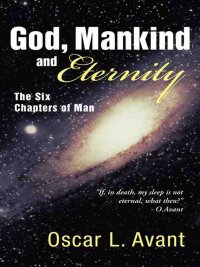
God Mankind and Eternity by Oscar Avant: a Review

Author’s background and intent

According to the publisher’s website, Oscar Avant is a retired engineering manager, and has served on the staff of churches in Silver Spring and Gaithersburg, MD. After I started reading this book, I looked for more information on his educational background, but could find none. His interest in this material is his passion for evangelism.


Summary

Avant’s intent is to offer a synopsis and commentary on the whole of the Biblical narrative.

The subtitle of the book is “Six Chapters of Man,” and this is how the book is organized. These chapters are:

  1. Creation
  2. Fall
  3. Flood
  4. Abraham
  5. Moses
  6. New Covenant

Avant summarizes and comments on these key events and the scriptural narrative that tells us of them.


Analysis

At the level of essentials, Avant seems to hold to the essentials of Christianity. He holds to Trinitarian theology, a high Christology, and the necessity of trust in the person and work of Jesus Christ for salvation. However, at the level of the details, some of his theology seems poorly articulated at best, and on shaky ground at worst. While the use of generic terms like “Great Spirit” may seem like how one would reach out to a biblically illiterate culture, (even if it is reminiscent of Native American folk religion) there are places that the author takes creative license without informing the reader of this. In a number of places, Avant makes hermeneutical comments that are odd. It seems to me that if a writer is going to do that, he could at least cite his sources. Examples include his detailed account of Satan’s rebellion, (19-20) as well as the claim that the angelic realm was created before the universe. Additionally he claims that when Adam was the only human, since there was no need for human language he spoke the “spirit language of all things” that even animals could use. (30) This may or may not be true. We are not told in Scripture, and that is where we must look for such information. If the author wants to speculate on this, he is welcome to do so, but he ought to make it clear that this is what he is doing.

If this was the worst of it, I would not waste pixels on it. It is the details he adds to the Genesis account of the origin and fall of humanity that gets weird. He claims that Adam was created with a “seed of Myself (God)” in him (21.) He later calls this an indwelling of the Holy Spirit. Further, his use of the analogy of humans as “triune” since they are body, soul and spirit, leads to the heresy of partialism. Come on, Patrick![1] Where his theology shows some shakiness is when he describes the Holy Spirit as being capable of moving at infinite speed. At this point you may think I am fussing about how many angels can dance on the head of a pin, but if you have a robust understanding of divine omnipresence, and understand that the Holy Spirit is God, then you see that God does not move through space since he is present everywhere, and he is non-spatial.

Based on a passage in Daniel, Avant claims that demons can stop prayers from reaching God. I will leave it to others how to tease this out in the context of Daniel. However, Avant makes similar claims about New Testament believers. However, if the Holy Spirit indwells New Testament believers, how is it even possible for any entity to interfere with our prayers reaching God, since the Spirit of God lives in us?

Avant also draws an artificial distinction between sin and evil behavior. He claims that sin did not exist before the law was given. However, he notes the judgment of God poured out in the Flood and on Sodom and Gomorrah.

Aside from some confusion he shows on the Incarnation, which errs close to seeing Jesus as two persons, most of what he has to say about the cross and salvation are orthodox.


Recommendation

Avant tells a fascinating story, and makes a detailed case for his views on the Gifts of the Spirit that are interesting. Moreover his writing is accessible for middle school age readers. However, I would not recommend this book to a non-Christian or a new Christian seeking to better understand the faith. They would come away rather confused.


Disclosure of Material Connection: I received this book free from the publisher through the BookLook Bloggers <http://booklookbloggers.com> book review bloggers program. I was not required to write a positive review. The opinions I have expressed are my own. I am disclosing this in accordance with the Federal Trade Commission’s 16 CFR, Part 255


[1] https://youtu.be/KQLfgaUoQCw

Is It Possible That God Exists?

I was recently asked to “prove that it is even possible for God to exist.” In order to answer this challenge, we need to define some key terms. I will leave off “prove” for reasons that I think will become clear.

When I speak of God, I am referring to a being that is all knowing, all powerful, everywhere present, unchanging, good, rational, wise, and loving, and holds all these attributes perfectly and without limit. He is also self-existent, which means he is not in any way dependent on anything or anyone else for his existence, rather all else that exists is dependent on God.

With respect to time, I hold that he is timeless without creation, but temporal since creation. This is important to note in order to explain how it is more reasonable to think God is the one who brought the universe, all of matter, energy, space, and time, out of nothing. It is my view that time is simply the relation of before/after, duration and interval between events, where an event is a change in the state of affairs. On this view, there was a state of affairs where all that existed was God. God created the universe, and with it time. He has since sustained the universe for some length of time (it is beyond the scope of this post to argue for how long that has been.)

So how does this prove that God is possible? Now we have to define possible. Philosophers divide possibilities into three modalities: logical, metaphysical, and physical.

“…on the standard model of the relation between these kinds of modalities the logical possibilities are the most inclusive; they include any proposition that sheer logic leaves open, no matter how otherwise impossible it might be. The metaphysical possibilities are the logical possibilities that are also allowed by the natures of all of the things that could have existed. The physical possibilities are the logical and metaphysical possibilities that are also allowed by the physical laws of nature. [1]

So rather than “prove” it is possible that God exists, I need only show that his existence is consistent with at least one of the above modes of possibilities.

Is there any law of logic violated by God’s existence, or even the proposition “God exists?” It is not an identity statement, so there is no violation of the Law of Identity. There is no compound proposition from which an excluded middle could be suggested, so there is no violation of the Law of the Excluded Middle. And, since there is no claim that God exists and does not exist at the same time in the same sense, there is no violation of the Law of Noncontradiction. So in this case, asking for proof of logical possibility is really asking for proof of a negative, and really the burden should be on the one who thinks it is logically impossible since it would be so easy to meet it, but that’s just my opinion.

Is God’s existence metaphysically possible? Metaphysics is the study of things and what kind of things they are. In a sense it is the study of what is and what can be. It seems to me that a being with the attributes listed above is the kind of being that is among those things that could have existed. There is nothing about such a being that is incoherent. For this distinction, however, let me illustrate the difference between metaphysical and logical possibility. It is strictly logically possible that the Prime Minister is a prime number (there is no violation of the laws of logic.) However, since prime numbers are not the kind of things that by nature are Prime Ministers, it is not metaphysically possible. To say that God is the creator and sustainer of the universe is logically possible, and metaphysically possible since the kind of being God would be is the kind of being that could create and sustain the universe. Conversely, it is not metaphysically possible that God is the Flying Spaghetti Monster since the FSM is a material being and material beings are not the kind of things that can exist timelessly and unchanging.

With respect to physical possibility, there is nothing in the laws of nature that precludes the existence of God. This is a separate issue from whether it is possible to empirically detect God. How we can even in principle know God exists is a distinct issue from whether it is physically possible. It may even be fair to say that to ask the question of physical possibility is a category error since God is not a physical being. However, something is possible just in case there are no impossibilities against it.

So in all three modalities, it is possible that God exists. Ordinarily, I think whoever is making a claim bears the burden, and I have tried to support my claim that God’s existence is possible. However, it seems that taking a stance that it is impossible is to hold that the idea violates logic, or God cannot be the kind of thing that could have existed, or that there is a law of nature that precludes such existence. I would love to hear which of these is the case with respect to God.

[1] http://plato.stanford.edu/entries/modality-epistemology/#PriPos

St. Arminius’ Bad Arguments (with apologies to Lutheran Satire)

Before my Arminian friends get their guard up, let me explain what this article is NOT. This is not a defense of Reformed theology. It is a critique of arguments offered in defense of Arminianism. I originally wanted to write a post about bad arguments for Arminianism and Reformed/Calvinist theology, but I could not find or recall enough from the Reformed side to write a post that would seem balanced, so I am hoping to generate comments from this post from which to build a second article about bad arguments for the Reformed view.

For an argument to be valid, the conclusion must follow from the premises, and to be sound, the premises must be more plausible than not. If you argue “If X then Y, X, therefore, Y” and I can show that X is false, (not sound) or that Y does not follow from X, (not valid) I have not shown that Y is false. Likewise, showing these to be bad arguments for Arminianism says nothing about the truth of Arminianism.

For those unfamiliar with the terminology of Arminianism and Calvinism (I have used the term “Reformed” because it is a little broader, but for my purposes here, I will switch to “Calvinism”) let me explain. In it’s simplest form, with respect to salvation, Calvinism holds that God’s election precedes one’s faith, (one comes to faith because God has elected him) and his non-election precedes one’s persistent lack of faith (one fails to come to faith because God has not elected him.) Arminianism holds that one’s faith precedes election, and persistent lack of faith precedes non-election.

Objections/Arguments

  1. Calvinism means double predestination. If God predestines people for Hell, it’s unfair.

The view that the non-elect are predestined for damnation is taught explicitly in Calvinistic circles. However, the Arminian view does not get God “off the hook” so easily. The Calvinist and the Arminian agree that, as Jesus said, God must draw one to Jesus before they will come. They disagree on whether this is done for all. The Calvinist believes that God draws the elect such that the elect will come. The Arminian holds that God draws all that they may come. Both views require action on God’s part for someone to put their faith in Jesus. Since God knows how everyone will respond to the Gospel, then by not drawing some so that they will respond, God could be said to be electing some to damnation. Both views entail God not drawing some so that they will respond. Therefore, God is just as responsible for the damnation of the nonbeliever on the Arminian view as he is on the Calvinist view (if it could be said that he is responsible at all.)

  1. Calvinism leaves no reason to evangelize since on their view the elect will be saved.

It may be the case that a Calvinist view could reduce one’s sense of urgency to evangelize, however we are not commanded to respond to our feelings, we are commanded to make disciples. God commands means and ends. If Calvinists are slow to evangelize because of their view, shame on them. However, Calvinism does not entail non-evangelism. The disobedience of Calvinists does not prove that Calvinism is false.

  1. Calvinists believe in “limited atonement” but the Bible says, “God so loved the world…”

Calvinists hold that Christ’s work on the cross only works for those who place their faith in him. Arminians (mostly, since their may be some who are universalists) hold that Christ’s work on the cross only works for those who place their faith in him. Limited simply means that it does not apply to those who do not place their faith in him.[1] Again, both groups see the atonement as limited.

  1. Calvinists believe in “limited atonement” but the Bible says, “…whosoever will…”

Calvinists also believe “whosoever will…” but on their view, the “whosoever” are the elect. Again, the debate is over how one comes to be a “whosoever.”

  1. “Irresistible grace” means people are saved against their will.

Arminians often see this doctrine as God acting in a manner that forces people to do something against their will. However, the Calvinist holds that God moves on the will in such a way that the elect person has no desire to resist.

Calvinist bad arguments

One bad argument I hear from the Calvinist side is “If human beings have libertarian free will, God is not/less sovereign. The problem with that is it assumes that God could not sovereignly choose to create human beings with libertarian free will. Similarly, I have heard it argued that if man has libertarian free will, God is dependent on man for his omniscience. However, this objection conflates the divine attribute of omniscience, which he has necessarily, and the content of God’s knowledge, which could be informed by the free choices of his creatures.

I hope my friends on both sides of the debate will comment on this. I intentionally omitted Molinist views (of which I am most sympathetic.) I would ask that any Molinists who comment will limit their comments to additional bad arguments.

[1] Exceptions may be children, people with developmental disabilities, etc.

Connecticut Bluegrass Association

“The Connecticut Bluegrass Association — or CTBA — is dedicated to bringing together the bluegrass community in CT, promoting Bluegrass Bands, Education, Jams, festivals, and event Venues.”

Think Divinely

How you think changes everything

Theology in Motion

Knowing God Should Move You

Amanda Casanova

Writing about running, faith, and the trouble my two dogs get into

Quodlibetal Blog

Musings from Anywhere by Dr. Richard G. Howe

31 Days of Prayer

A month-long call to prayer and fasting

Bible Backgrounds

Research and Commentary from Dr. Craig Keener

Boon4You

If You Disagree With Me...You're Probably Wrong.