The Crusades: Just War or Just War? An Afterthought

How then should we understand the Crusades?

Jesus commands his disciples, “All authority in heaven and on earth has been given to me.  Therefore go and make disciples of all nations, baptizing them in the name of the Father and of the Son and of the Holy Spirit, and teaching them to obey everything I have commanded you. And surely I am with you always, to the very end of the age.” (Matthew 28:18-20) At no point does Jesus ever command us to promote the Gospel by force of arms. The Crusades were called and executed in the context of 700 years of conflation between ecclesiastical and political power. The Christian faith, which began as the faith of individuals who came to the faith and joined a community in the face of resistance from the governing authorities, had been reinvented as a community whose membership was mandatory, even on pain of death. In this context, and in the absence of access to the Scriptures by common people, it is not hard to imagine how people who cared deeply about such things as relics and holy places could be motivated to endure great hardship to carry the fight to Palestine. Such people, lacking sound leadership, could even be persuaded to commit heinous acts and think they were rendering service to God. All this is a valid criticism of Christendom, if by this you mean the church/state body that led much of medieval Europe. To use the crusades as a critique of Biblical Christianity is to attack a straw man.

The Crusades: Just War or Just War? Part 2

Happy New Year!

In my last post, I began to lay out the historical background for and description of the Crusades. This is a continuation of the same.

Although there has been a popular misconception of how tolerant Muslims are of people of other faiths living within conquered territories. As Stark describes it:

In principle, as “People of the Book,” Jews and Christians were supposed to be tolerated and permitted to follow their faiths. But only under quite repressive conditions: death was (and remains) the fate of anyone who converted to either faith. Nor could any new churches or synagogues be built. Jews and Christians also were prohibited from praying or reading their scriptures aloud—not even in their homes or in churches or synagogues—lest Muslims accidentally hear them.[1]


This is in addition to they way Jews and Christians were treated as second-class citizens. Nevertheless, these conditions were tolerable compared to what came with Seljuk Turk conquest.

While the cries of “God wills it!” may have been a response to the reports of what was happening in Palestine, the call for the First Crusade were not. Pope Gregory VII planned to call for the crusade in order to assist the Byzantine Emperor with the defense of Constantinople and the recovery of Byzantine territory from the Seljuk Turks. Byzantines had good reason to fear conquest by the Turks. In 1064 the Turks laid siege to the Armenian capital, Ani. Hoping to spare the inhabitants, the city surrendered. Stark relates the account of “an Arab historian Sibt ibn al-Gawzi (d. 1256), who claimed to be quoting an eyewitness: ‘The army entered the city, massacred its inhabitants, pillaged and burned it…The dead bodies were so many that they blocked all the streets.’”[2] Likely aware of these events, those who heard of the Turks treatment of holy sites and pilgrims in Palestine would have been credible. Rather than a “mandate to destroy the infidel in the Holy Land,” the First Crusade was a call to repel a vicious invader from the Byzantine Empire, and to liberate Jerusalem from an oppressive conqueror.

Haught’s article continues,

Gathering crusaders in Germany first fell upon “the infidel among us,” Jews in the Rhine valley, thousands of whom were dragged from their homes or hiding places and hacked to death or burned alive. Then the religious legions plundered their way 2,000 miles to Jerusalem, where they killed virtually every inhabitant, “purifying” the symbolic city. Cleric Raymond of Aguilers wrote: “In the temple of Solomon, one rode in blood up to the knees and even to the horses’ bridles, by the just and marvelous judgment of God.[3]


Madden relates the Rhine Valley incidents:

The most infamous of the anti-Jewish crusade leaders was Count Emicho of Leiningen. On a rather pronounced detour, he and his followers marched down the Rhine plundering and massacring Jews in the cities of Speyer, Worms, Mainz, Trier, and Cologne. Some local bishops did their best to protect the Jews, but many were killed all the same. In Mainz, Emicho’s men stormed the palace of the bishop, where the Jews had taken refuge.[4]


On these accounts, it would seem that the crusader armies went on an anti-Semitic rampage on the way to Palestine, which met with token resistance from local bishops. What really happened, however, is that three small groups of Germanic knights began to attack Jews. Principal among these was Emicho of Leiningen. In each of the cities mentioned in Madden’s account, the local bishop tried to shelter the Jews with mixed results. Volkmar and Gottshalk committed similar attacks. All three groups were destroyed when they tried to repeat this pattern in Hungary.[5]

As for the “religious legions plunder(ing) their way 2,000 miles to Jerusalem,” they must have been incredibly inept at plundering. As Stark tells us, “Large numbers of the poor noncombatants with the crusaders actually starved to death.”[6] (This incident was in the context of the siege of Antioch.)

Haught’s complaint that the crusaders “killed virtually every inhabitant, ‘purifying’ the symbolic city” needs to be examined in its historic context. As Stark explains

…the commonly applied “rule of war” concerning siege warfare was that if a city did not surrender before forcing the attackers to take the city by storm (which inevitably caused a very high rate of casualties in the besieging force), the inhabitants could expect to be massacred as an example to others in the future.[7]

Stark also argues that “no sensible person will believe Raymond of Aguilers’s report that “men rode in blood up to their knees and bridle reins.” In fairness, however, it does seem odd for a churchman to exult in bloodshed like this. In a similar, Haught claims, “As Saint Bernard of Clairvaux declared in launching the Second Crusade: ‘The Christian glories in the death of a pagan, because thereby Christ himself is glorified.’”[8] This case is a mixture of fact and fiction. Bernard did not say this in relation to the Second Crusade, but he did say it. Such a statement is incompatible with Christianity. Ezekiel 33:11 says “As surely as I live, declares the Sovereign LORD, I take no pleasure in the death of the wicked, but rather that they turn from their ways and live.”

In spite of the documented rationale for the Crusades, which was one of defense of territory and the protection of pilgrims, there is still a popular notion that it was a war of one religion against another. I have argued above that this was the case for the Muslim, but it is not clear this was the case for Christianity. This is not to say there were no Christians who joined the crusades in order to fight Islam. There may have been an anti-Muslim attitude among a majority of crusaders. The goal of the crusades, however, was not the defeat of Islam, but the liberation of Christian territories. Nevertheless, Emran Qureshi and Michael A. Sells argue:

The crusade was, at least at its inception, the war of Christendom against the Muslims. With the Crusades, the Christian attitude toward the Muslims began to differ from Christian attitudes toward other known peoples. What distinguished the Christian attitude toward the Muslims was its fundamentally antagonistic nature.[9]

It is ironic to note that no mention is made here of the jihad that had been waged by various Muslim groups since Mohammed, particularly the invasions which the crusades were called to repel. That being said, it is popular in today’s culture to read any critique of a system, such as Islam, as an “attack” on the adherents. (Unless of course the system is Christianity, in which case it is fair game.) In his treatise On War Against the Turk, Luther is quite clear in his comments that it is Islam that the Christian ought to oppose in his disposition, and the invading Turk that must be opposed militarily.

[1] Rodney Stark, God’s Battalions: the Case for the Crusades, Reprint ed. (New York: HarperOne, 2010), 39.


[2] Ibid., 104

[3] Haught.


[4] Madden, 18.


[5] Stark, 138

[6] Stark, 159-160.


[7] Ibid., 168


[8] Haught.

[9] Emran Qureshi and Michael A. Sells, The New Crusades: Constructing the Muslim Enemy (New York: Columbia University Press, 2003), 206.
The Crusades: Just War or Just War? Part 1

Since Islam has been in the news lately and comparisons made between ISIS and the Crusades, I thought it might be helpful to offer some historical background here. In this post and the next one, I will present a paper I wrote in graduate school.

Background

The crusades were a series of campaigns launched against enemies of Christendom between 1095 and 1291.[1] They have been used as rationale for everything from skepticism and rejection of the gospel to the September 11 attacks. Accounts of the crusades from the period and since tend to either vilify or glorify them, with little in between. Critics often cite the crusades as evidence of the evil of Christianity. Crusades are seen as wars of colonialism against a peaceful Islamic civilization minding its own business until those mean, nasty Christians came to steal, kill and destroy. But is this an accurate picture? How did Muslims come to occupy Palestine, North Africa, Spain, and Anatolia? Did they come on bicycles wearing white shirts and ties, two at a time, bringing their message and winning converts? Did they win over the people through a series of camp meetings that led the masses to repent and accept Allah as their God and Mohammed as His prophet?

Like every war fought in history, the crusades had heroes, villains, beneficiaries and victims. In this paper, I will seek to set the record straight where the crusades are used to discredit Christianity. This is not, however, a defense of Christendom.

The structure of this paper will be to take criticisms offered and respond to them, whether by refutation, or concession where the criticisms are valid.

The Crusades

James Haught, in an article first published in Penthouse magazine, wrote, “The First Crusade was launched in 1095 with the battle cry “Deus Vult” (God wills it), a mandate to destroy infidels in the Holy Land.” [2] One would think from this statement that whoever called for the crusades just arbitrarily decided to tell Christians that they should go and “destroy infidels in the Holy Land,” who are simply minding their own business, because “God wills it.” Reality, as is often the case, is more complicated.

For Muslims, war was part and parcel with Islam, claims by George W. Bush that Islam is a “religion of peace” notwithstanding. Madden explains:

Traditional Islamic thought divided the world into two spheres, the Dar al-Islam (“Abode of Islam”) and the Dar al-Harb (“Abode of War”). The Dar al-Islam consisted of all of those lands directly ruled by Muslims and subject to Islamic law. Dar al-Harb, which included the Christian world, was the place in which Muslims were enjoined to wage jihad against unbelievers, capturing their lands and subjecting their peoples.[3]

Consequently, Muslims did not come to control the Holy Land, or Egypt, or Syria, or Persia through immigration, or friendship evangelism. They had conquered these lands by military force. This does not necessarily justify the first crusade, but the historic context needs to be considered as we evaluate it. Even at this point no call went out to expel the Muslim. Muslim treatment of Christians in the conquered territories did not seem to warrant such a response. It should also be noted that the cries of “God wills it!” came from those who answered the call, not those who issued it. It was a response to the reports of what was happening to the churches and pilgrims in the Holy Land.

In my next post, I will explain what changed and how it led to the first Crusade.

[1] Thomas F. Madden, The New Concise History of the Crusades, Updated ed. (Lanham, MD: Rowman & Littlefield Publishers, 2005), xvii.

[2] James Haught, “Holy Horrors,” The Secular Web, entry posted 1997, http://www.infidels.org/library/modern/james_haught/holy.html (accessed December 6, 2012).


[3] Madden, 3.

Born Again: Why Christianity is Not What You Think by Jim Barringer: A Review


The Author

Jim Barringer has a Bachelor’s degree in Education from Anderson University, and an MA in Biblical Studies from Southwest Seminary. He is worship and teaching Pastor at The Church of Life in Orlando, Florida.

Synopsis

The phrase “born again,” is taken from John 3:3. It has taken on a variety of meanings, and in contemporary culture it has gained some unfortunate baggage. Barringer seeks to help the reader understand what it really means and why it matters. The book is structured in 7 semi-linear chapters. I say “semi-linear” because there are references and connection between chapters that are coherent, but unconventional. This manages to avoid making the book confusing.

The author lays the groundwork by expositing the dialogue where the phrase first appears, notes that it is a mandate and not an option, and points to its centrality to our identity. He then demolishes the idea that there are good people (apart from God) and lays out our need for rebirth. After explaining the sin issue, he then spends the next three chapters unpacking the command to love God and others and what that should look like.

Analysis

Barringer does an excellent job making these ideas accessible to those interested in understanding the Christian life from conversion through the sanctification process right up to the eschaton. In other words, from joining oneself to Jesus, to the growth process, right up to life in the new heavens and new earth. Many books like this have been written, but few, if any, with this level of transparency on the part of the author. Barringer is refreshingly honest about his own struggles and failures in his life. It is good to know that even those in leadership struggle beyond the occasional “yes, I struggle too” thrown in as a formality. While there are a few places that a theology nerd like me might take issue, they are not nearly important enough to mention here.

Recommendation

This book is a must read for anyone who is frustrated with the christianese platitudes they get when they look for advice on the Christian life, or any serious seeker who is confused by the many voices competing for their attention. It is accessible for readers from middle school up, and intelligent enough for a PhD. Even experienced Christians can be refreshed and reminded of what is important.

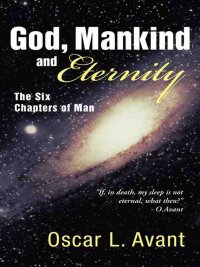
God Mankind and Eternity by Oscar Avant: a Review

Author’s background and intent

According to the publisher’s website, Oscar Avant is a retired engineering manager, and has served on the staff of churches in Silver Spring and Gaithersburg, MD. After I started reading this book, I looked for more information on his educational background, but could find none. His interest in this material is his passion for evangelism.


Summary

Avant’s intent is to offer a synopsis and commentary on the whole of the Biblical narrative.

The subtitle of the book is “Six Chapters of Man,” and this is how the book is organized. These chapters are:

  1. Creation
  2. Fall
  3. Flood
  4. Abraham
  5. Moses
  6. New Covenant

Avant summarizes and comments on these key events and the scriptural narrative that tells us of them.


Analysis

At the level of essentials, Avant seems to hold to the essentials of Christianity. He holds to Trinitarian theology, a high Christology, and the necessity of trust in the person and work of Jesus Christ for salvation. However, at the level of the details, some of his theology seems poorly articulated at best, and on shaky ground at worst. While the use of generic terms like “Great Spirit” may seem like how one would reach out to a biblically illiterate culture, (even if it is reminiscent of Native American folk religion) there are places that the author takes creative license without informing the reader of this. In a number of places, Avant makes hermeneutical comments that are odd. It seems to me that if a writer is going to do that, he could at least cite his sources. Examples include his detailed account of Satan’s rebellion, (19-20) as well as the claim that the angelic realm was created before the universe. Additionally he claims that when Adam was the only human, since there was no need for human language he spoke the “spirit language of all things” that even animals could use. (30) This may or may not be true. We are not told in Scripture, and that is where we must look for such information. If the author wants to speculate on this, he is welcome to do so, but he ought to make it clear that this is what he is doing.

If this was the worst of it, I would not waste pixels on it. It is the details he adds to the Genesis account of the origin and fall of humanity that gets weird. He claims that Adam was created with a “seed of Myself (God)” in him (21.) He later calls this an indwelling of the Holy Spirit. Further, his use of the analogy of humans as “triune” since they are body, soul and spirit, leads to the heresy of partialism. Come on, Patrick![1] Where his theology shows some shakiness is when he describes the Holy Spirit as being capable of moving at infinite speed. At this point you may think I am fussing about how many angels can dance on the head of a pin, but if you have a robust understanding of divine omnipresence, and understand that the Holy Spirit is God, then you see that God does not move through space since he is present everywhere, and he is non-spatial.

Based on a passage in Daniel, Avant claims that demons can stop prayers from reaching God. I will leave it to others how to tease this out in the context of Daniel. However, Avant makes similar claims about New Testament believers. However, if the Holy Spirit indwells New Testament believers, how is it even possible for any entity to interfere with our prayers reaching God, since the Spirit of God lives in us?

Avant also draws an artificial distinction between sin and evil behavior. He claims that sin did not exist before the law was given. However, he notes the judgment of God poured out in the Flood and on Sodom and Gomorrah.

Aside from some confusion he shows on the Incarnation, which errs close to seeing Jesus as two persons, most of what he has to say about the cross and salvation are orthodox.


Recommendation

Avant tells a fascinating story, and makes a detailed case for his views on the Gifts of the Spirit that are interesting. Moreover his writing is accessible for middle school age readers. However, I would not recommend this book to a non-Christian or a new Christian seeking to better understand the faith. They would come away rather confused.


Disclosure of Material Connection: I received this book free from the publisher through the BookLook Bloggers <http://booklookbloggers.com> book review bloggers program. I was not required to write a positive review. The opinions I have expressed are my own. I am disclosing this in accordance with the Federal Trade Commission’s 16 CFR, Part 255


[1] https://youtu.be/KQLfgaUoQCw

Balancing Safety with Security: Another Perspective

There has been a lot of discussion about the Syrian refugees and whether Christians should support allowing them to come to the U.S. Many of the concerns raised stem from the possibility that there may be terrorists mixed in, and the idea that Christians are underrepresented among them. (Jonathan Witt addresses this here.) Unfortunately all of the focus seems to be on these two issues. Maybe there is a third issue we are overlooking to our shame.

Syria is a Muslim nation, and under the best of circumstances, it is hostile to Christian missionary work. Add to that the current civil war, and you have a recipe for near certain martyrdom for any Christian who wants to go there to bring the Gospel. In this, I am reminded of a story I heard Ravi Zacharias tell about a man named Sami Dagher. As I recall, Sami Dagher was in Lebenon when Syria invaded in 1976. Dagher told Zacharias that he was complaining in his prayers about the Syrian occupation, when he felt God telling him that he had always complained that he could not bring the Gospel into Syria, and now he sent him 25000 Syrians and he was still complaining. (Paraphrased from memory. I could not find a link on the rzim.org site. I am sure I heard in in a  Let My People Think podcast.)

The point is, we can point out how the Muslim nations in the region are not welcoming any refugees if we want, but none of us are planning any missions trips to Syria any time soon. What we have is an opportunity to share the love of Christ with these refugees in a place where they can safely receive it. (I know there are still hazards from within their community.) Is that safe? Maybe not, but we are not called to be safe, we are called to be faithful. We can push for due diligence with respect to vetting the refugees, but they will probably come, and we need to be prepared to welcome them.

Reflections on the Skeptics Forum

Tonight, I attended a panel discussion between neurologist Steven Novella and RTB‘s Hugh Ross and Fazale Rana. Ross gave a presentation defending Biblical theism from the origin and design of the universe, galaxy and solar system, and Rana did so from the origin of life. Novella then offered a rebuttal. After some dialogue among the panelists the floor was opened for a brief Q&A.

The Good

Ross is second to none when it comes to explaining all of the parameters that must be fine tuned in order for life to be possible anywhere in the universe, and how these parameters point to a creator who seemed to want organisms a lot like humans to live on earth. Likewise, Rana presented a strong case for a sudden origin of life which is inconsistent with typical naturalistic models. Novella’s critique of Ross and Rana’s Biblical concordism was also informative. (More on that below.) Concordism in this context means the idea that there is a strong (in the case of strong concordism) correlation between scientific discoveries and Bible passages.

The Bad

There is a well respected principle of Bible hermeneutics (the science of interpretation) that says “A passage can never mean what it never meant.” Isaiah 45:12 says, “It is I who made the earth, and created man upon it. I stretched out the heavens with My hands And I ordained all their host. “Ross claims that this and other verses that say similar things, is a reference to the expansion of the universe. There is no good reason to think the Israelites to whom Isaiah was writing 2700 years ago would have understood him to be speaking of the expansion of the universe. This strongly suggests Ross is mistaken. Moreover, Rana, who in my opinion destroys naturalistic origin of life hypotheses in his written work, tried to tie Genesis 1:2 to the origin of life. Now THAT was stretching on a cosmic scale. (Sorry, guys. I couldn’t resist.) For his part, Novella trotted out the “god-of-the-gaps” charge against Ross and Rana, while appealing to naturalism-of-the-gaps to explain the lack of scientific answers to the question of the origin of the universe and of life. He claimed that all scientific adjustments to models accommodated new evidence while anything tied to a theistic model adjust to avoid evidence.

He also claimed Ross and Rana, and those who think like them, are guilty of what he called “retroactive continuity.” This is similar to the “humans are pattern recognizing organisms” claim. He accuses creationists (in the broad sense) of taking what we know now and applying Bible texts to it retroactively to harmonize them, as if Darwinism does nothing similar. In conversation afterward, Novella denied Darwinism is vulnerable to the same charge because it made successful predictions. He claimed Darwinism predicted DNA because it posited heredity. This is another cosmic stretch, since even the simplest organism has an incredibly complex genome, not to mention Darwinism’s inability to account for the origin of information. (For the purposes of this article, I am using Darwinism and neo-Darwinism interchangeably since the difference is not relevant to the point.)

The Christian worldview holds that God created the universe out of nothing. Genesis 1:1 is consistent with this, even if some would argue it is not stated there, and Hebrews 11:3. However, the Christian worldview does not stand or fall on a particular interpretation of Genesis or other passages with respect to science, since it is not a science text. For example, C. John Collins notes the style and structure of Genesis 1 is distinct from straightforward historical narrative. He calls the style, “exalted prose.”[1] This is part of an argument he makes for an interpretation of Genesis 1 that shows it was not intended to teach how or when God created the universe. This is just one of several interpretations of Genesis, and related texts, that make better sense of the texts.

Ross and Rana do great work on scientific evidence that is consistent with the involvement of an intelligent agent in the design and creation of the universe and life. I wish they would apply more care to hermeneutics.

For his part, I am sure Dr. Novella is a fine neurologist. However, this is only possible because he is made in the image of God. His own worldview cannot account for how he could have a reliable understanding of his discipline.

[1] C. John Collins. Genesis 1-4: A Linguistic, Literary, And Theological Commentary (Kindle Location 530). Kindle Edition

Is There a Pattern Here?

Is there intelligence out there?

Today I was listening to Justin Brierley’s Unbelievable podcast and during the conversation between Jonathan McLatchie and Corey Markum, Markum raised the claim that humans were “pattern-recognizing creatures,” and offered an evolutionary account of this idea. While the claim makes for a nice just-so story that fits into the evolutionary paradigm, as several others, such as Tim Stratton, have pointed out, such a scenario does not show how rationality could develop. Moreover, there is no reason to argue an equally plausible just-so story that humans are “religious-truth-denying” creatures. After all, just as the fact that humans have the rational capacity to recognize patterns, and to infer explanations from them does not tell us whether those patterns are really what we think they are, likewise, the impulse to reject religious claims does not tell us they are false.

Sorry, you have reached your bag limit for Red Herring

Frankly, in the context of a debate on the design inference, raising the “pattern-recognizing creature” line is meaningless at best, and question-begging at worst. When ID proponents point to evidence in nature of design, and the Darwinist plays the “pattern recognition” card to explain it away, why does this not also apply to the neo-Darwinian hypothesis? For whatever reason, humans have the capacity to recognize patterns and draw inferences from them. The only difference between ID and the Darwinist is the philosophical presuppositions.

Method to their madness

Scientists operate on a principle known as methodological naturalism (MN). On MN, the scientist operates on the assumption that some feature of the natural world under investigation will have a natural cause. This is all well and good, until it becomes a science-stopper. After all, several scientific disciplines diverge from this approach by necessity. Fornesics, archaeology, and SETI (Search for Extra Terrestrial Intelligence)  are three such disciplines. Markum’s claim to the contrary, these disciplines do not presuppose intelligent agency as a cause, but intelligent agency is a live option. They investigate sets of evidence to see if they have a natural or intelligent cause. However, since MN is often conflated with metaphysical naturalism, intelligent causes are not considered a possibility. On Metaphysical Naturalism, the natural world is all that exists. This a philosophical approach to science, not a scientific approach to the data.

Designer Genes?

The bottom line is that those who support Intelligent Design theory simply note that the natural world contains evidence of the activity of an intelligent agent. While the evidence they present can be used to support the Design Argument for the existence of God, ID and the Design Argument are not the same thing. Those who are skeptical of ID should deal with it on its merits instead of trying to confuse the issue by accusing ID proponents of trying to sneak religion into science.

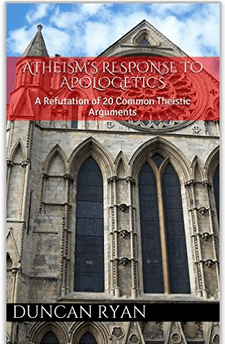
Atheism’s Response to Apologetics Part 2

Since Ryan claims the objective of his book is to respond to bad arguments, I can’t find too much fault with his response to the form of the Moral Argument he quotes in the second chapter. However, not having seen or heard this form, I can’t help but wonder if there isn’t a Straw Man under attack here.

I am not aware of any theists who justify belief in God by the existence of a concept of morality. Rather the fact that we have moral intuitions leads us to ask what grounds them.

Ryan offers an evolutionary explanation for moral codes, but not one for moral intuitions. If all we had were rules we had to learn, he might have a point, but there are good reasons to think we have moral intuitions before we learn moral codes. As parents we often appeal to a young child’s empathy to correct their behavior. However, that empathy does not account for the “oughtness” of acting according to it. Just because I can imagine how it would feel to be the victim of my actions does not explain why I should not do those actions. In fact in some cases, I ought to do them anyway.

Ryan points to cultural differences as evidence of relativism, but these differences are far more about the facts that inform the application of moral principles than the principles themselves.  He notes an example of an objective moral principle, the wrongness of murder, but jumps quickly back to denying a logical connection to theism.

Comparing moral codes of various religions adds nothing to the discussion since revealed codes are not central to the argument.

Finally, since moral arguments are defeaters for atheism, and not arguments for a particular deity, noting that they do not prove one as more plausible than another is a red herring.

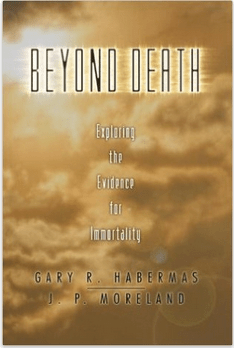
Beyond Death by Gary Habermas and J.P. Moreland

A review.

The Authors

Gary Habermas is Distinguished Professor and Chair of the Department of Philosophy and Theology at Liberty University. He is the author or coauthor of 12 books including The Case for the Resurrection of Jesus with Michael Licona, In Defense of Miracles with Douglas Geivett, and Forever Loved.

J.P. Moreland is Distinguished Professor of Philosophy at Talbot School of Theology, Biola University. He has authored or coauthored 16 books including Kingdom Triangle, The Lost Virtue of Happiness, and Scaling the Secular City. Both authors have dedicated their professional lives to making disciples by teaching them to think carefully about their faith, or in the words of one of Moreland’s titles, to “Love the Lord with all your mind.”

Synopsis

In Beyond Death, Habermas and Moreland examine several lines of argument and evidence for life after death, the Christian worldview, and the implications for this present life.

The book is divided into three sections. Part One lays out the case for immortality by offering reasons to believe in the existence of God, the case for substance dualism, the case for the resurrection of Jesus, and accounts of near-death experiences (NDEs.) Part Two explains the Biblical view of the intermediate state between death and the final resurrection, responds to the case for reincarnation, and describes Heaven and Hell. Part Three lays out the implications for these things for how we ought to live, face death, and the implications for bioethics with respect to edge-of-life issues.

Analysis

Beyond Death is a thorough treatment of questions concerning ultimate reality. Habermas and Moreland show how the evidence points to their conclusion without whitewashing things that don’t fall neatly into place. While they acknowledge NDEs in which the NDEr had a religious experience, they do not press these very far given the inability to verify the claims, as well as the inconsistency of them. Moreover, in their response to evidence of reincarnation, they are willing to explore explanations that some may not feel comfortable with.

Beyond Death is especially helpful in that while there are many books and articles making the case for the Christian worldview from philosophy and history, this book offers credible, contemporary experiential evidence. The book is accessible to the high school level reader. I recommend it for personal or group study.

Connecticut Bluegrass Association

“The Connecticut Bluegrass Association — or CTBA — is dedicated to bringing together the bluegrass community in CT, promoting Bluegrass Bands, Education, Jams, festivals, and event Venues.”

Think Divinely

How you think changes everything

Theology in Motion

Knowing God Should Move You

Amanda Casanova

Writing about running, faith, and the trouble my two dogs get into

Quodlibetal Blog

Musings from Anywhere by Dr. Richard G. Howe

31 Days of Prayer

A month-long call to prayer and fasting

Bible Backgrounds

Research and Commentary from Dr. Craig Keener

Boon4You

If You Disagree With Me...You're Probably Wrong.