Questioning Islam by Peter Townsend: a Review

I typically begin my reviews with some information about the author and his qualifications and interests in writing his book. In the case of Peter Townsend, I could find nothing. It could be because it is a pseudonym, which given the subject matter of this work, may be a wise thing. It is hard to issue a fatwa against someone if you don’t know who he or she is. Since I do not read or write Arabic, I am in no position to evaluate his research, but everything he says in Questioning Islam is consistent with everything else I have read from known sources, so I have no reason to doubt his conclusions.

After defending the book itself, Townsend anticipates objections that can arise from his arguments and offers a brief sketch of Islam’s history and teachings. What then follows is a detailed critique of the origin, teachings, and practices of Islam, using highly respected Islamic sources for each, as well as noting the lack of archaeological evidence for the city of Mecca before the formation of Islam.

Townsend notes the interesting absence within the Qur’an itself of the Five Pillars of Islam (these are found in the ahadith,) but a plethora of what seem to be very convenient “revelations” that seem to serve Mohammed well in his circumstances. He also offers rebuttals to claims of originality, citing many earlier sources that contain texts very close to several suras, as well as the gap of at least 200 years between the death of Mohammed and the earliest trusted hadith. Finally, Townsend critiques many Islamic teachings in light of modern sensibilities.

Townsend never states what his religious views are in this book. His stated purpose is to encourage Muslims to examine their beliefs and the reasons they have for holding them. However, while demolishing Islamic teaching, he offers no alternative. This comes in stark contrast to works by authors such as Nabeel Qurreshi, who encourages building relationships with Muslims and earning their trust before offering such comments. As a Christian, I would recommend this book as an informational resource for Christians reaching out to Muslims, but not as a model for that outreach. Townsend’s tone is a little triumphalist when he presents damning evidence against the claims of Islamic texts. Moreover, Townsend’s critique of some teaching is based on how they compare to modern sensibilities. However, this tells us nothing about whether or not they are true. There are Christian teachings, which I think are true that could also be said to be “out of touch…” It is hard to imagine expecting a Muslim to read Questioning Islam and coming away with a willingness to engage in a dialogue. As an apologist, if I offer a critique of a person’s beliefs that seem to be false, it is for the purpose of offering them a true alternative that will actually be good for them to embrace. Moreover, it only makes sense that if you are going to try to persuade someone to abandon beliefs they hold dear, you need to be very sensitive in your approach. Townsend seems to take a little too much satisfaction in finding the problems in Islam. Moreover, to emulate this tone leaves little possibility that the Muslim will be open to whatever alternative I have to offer.

The Challenge of Islam: Does Early Testimony Matter to Muslims?

A great post by Eric Chabot

chab123's avatarTHINKAPOLOGETICS.COM

Just this past week I had the opportunity to speak to some Muslims about one of the largest differences in our faith and their faith. For Christians, the death and resurrection is central to the Gospel message. After all, the “Kerygma” in the Book of Acts is the Messiah was crucified according to the plan of God (Acts 2:23) and that He was raised from the dead and appeared to his disciples (Acts 2:24; 31-32; 3:15-26;10:40-41;17:31;26:23). But for Muslims, they think Jesus didn’t die. Instead, the early disciples were deceived and Allah delivered Jesus. It says in Sura 4:156-157:

“And [for] their saying, “Indeed, we have killed the Messiah, Jesus, the son of Mary, the messenger of Allah .” And they did not kill him, nor did they crucify him; but [another] was made to resemble him to them. And indeed, those who differ over it are in doubt about it. They have…

View original post 1,635 more words

Hire Your Neighbor As Yourself 

As I listened to one of my favorite podcasts this morning, the issue of doing business with companies that support causes with which I disagree came up. As I reflected on the question, the thought occurred to me that maybe we hold these businesses to a double standard. We think we are standing for what is right if we withhold our business because we don’t want our money going to these causes, but what if the tables were turned? Suppose your employer called you in and said, “I hear that ten percent of our money we pay you goes to your church. We don’t support churches here, so, you’re fired.” Most of us would be outraged. We might even sue the employer for violating our rights. 

This is not to say that companies that support these causes have a right to our business, but maybe we are a little hypocritical in our approach. At the very least I think we are under no obligation to refuse to buy goods and services from them. 

Free will musings

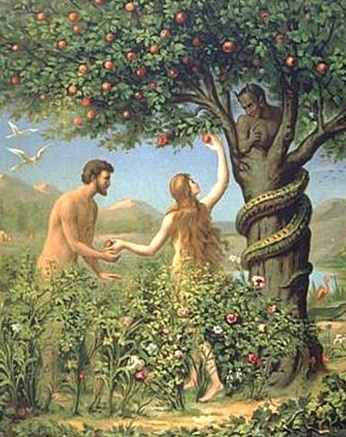
In our mid-week Bible study, I was reminded of something I had just read in a book earlier in the week. People sometimes wonder why the Tree of the Knowledge of Good and Evil was placed in the Garden of Eden. (Genesis 2, 3) It occurred to me that since God is the Creator and Sustainer of everything in the universe, there is no material thing we could give Him as an act of worship. All we can give Him is the one thing within our power to withhold from Him; our willing obedience. With the placing of the tree in the garden, there was the opportunity to willingly obey, or to withhold obedience. Without such a choice, there was no way for Adam and Eve to express love to God in any objective, meaningful way. Sure they could have said, “I love you.” But, those words are meaningless without actions to back them up. This is confirmed by Jesus’ words, “If you love Me, you will keep My commandments.” (John 14:15)

Another issue that came to mind is the circumstances Adam and Eve were in. It is common for us to blame our circumstances for our sinful choices. If I could only feel God’s presence in my life, I would be better able to resist temptation If I only had more of this, or less of that, etc… However, the account of Adam and Eve’s fall in Genesis 3 shows this is nonsense. No other human being before Jesus walked in closer relationship to God, unspoiled by sin, than Adam and Eve before the fall. They had all they needed and all they could want. Yet, they still sinned. If we think we would make better choices than that, we are fooling ourselves.

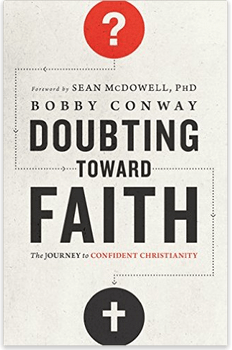
Doubting Toward Faith By Bobby Conway: A review

Bobby Conway is a lead pastor of LIFE Fellowship, Charlotte, and the One Minute Apologist on YouTube. No stranger to seasons of doubt in his own life, Conway brings his experience, Biblical teaching, and careful thinking to the issue of dealing with doubt.

Through ten chapters, Conway explains the effects of doubt on the mind, the church, and one’s faith, the universality of doubt, and the hazards related to leaving them unexamined. Moreover, even when none of our friends can deal with our doubts, Jesus can.

Conway explains how doubts arise, some of the most common types, and the roots. Then he shows how to work through it, especially noting how faith is grounded in reason, not credulity.

Conway spends a lot of ink describing the experience of doubt, and at first this struck me as filler. However, having read it, it occurs to me that he has done a masterful job of helping the reader who has not recently dealt with serious doubt feel the weight of the experience. Moreover, for the reader who is struggling, or has done so recently, Conway’s description helps them see that he is not approaching this from a cold, academic point of view.

Doubting Toward Faith is a must-read for anyone plagued by doubts in their Christian faith, but even better to read it without waiting for the doubts to come. How much better to be ready beforehand?

This book is suitable for readers from high school students to college professors. It would also make an excellent resource for small group study.

Lioness of Planned Parenthood Guards Pride, Not Cubs

An excellent analysis by my friend Grant Bresett

Grant Bresett's avatarThe Apologers

Planned Parenthood logoThe Lioness is a symbol of strength – more specifically, feminine strength. That strength is usually found in the ferocity used to protect her young.

With Planned Parenthood, the young are the ones in danger because of the lioness.

The first five videos reveal Planned Parenthood profiting from selling aborted body parts (videos 1-4video 5). In this sixth video, Holly O’Donnell, Ex-Procurement Technician with StemExpress LLC,  heaps more testimony onto the pile of evidence against Planned Parenthood.

The latest video uncovers Planned Parenthood’s blatant disregard for women.

This goes to the heart of pro-abortion arguments. They sell themselves as champions of women’s health and women’s rights. This video shows Planned Parenthood exploit women for fetal body parts and financial gain.

Those who’ve been following Planned Parenthood are not surprised. These videos, however, make it accessible for everyone to see.

The Coercion

“She told me, she’s like, it’s not an option. It’s a demand…

View original post 483 more words

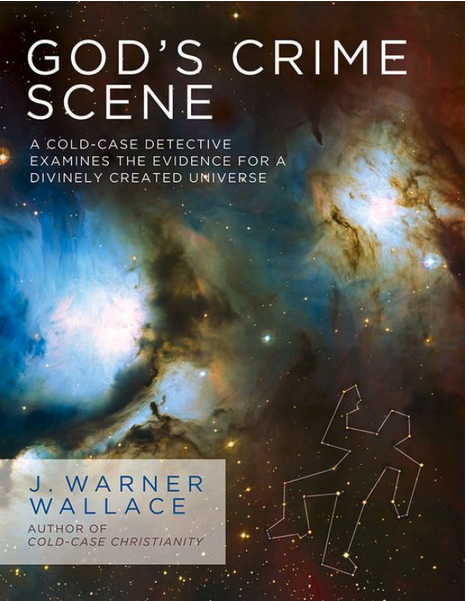
God’s Crime Scene: A Cold-Case Detective Examines Evidence for a Divinely Created Universe. A Review

God’s Crime Scene: A Cold-Case Detective Examines Evidence for a Divinely Created Universe.


By J. Warner Wallace

A Review

Warner Wallace is a recently retired cold-case homicide detective, and author of Cold-Case Christianity. Wallace is a popular speaker and Christian apologist. He is also an adjunct professor of Apologetics at Biola University. Wallace has undergraduate and graduate degrees in Design and Architecture, and an MA in Theological studies. This varied background come together in the writings of both Cold-Case Christianity and now, God’s Crime Scene: A Cold-Case Detective Examines Evidence for a Divinely Created Universe.

Wallace’s approach is to examine the universe in the same way he would examine the scene of a death in order to determine a cause. In the case of a death scene, where a dead body is found in a room, there can be only four possible explanations:

  • Natural causes
  • Accident
  • Suicide
  • Homicide

Wallace points out that if all the evidence related to the death of the person can be explained from within the room, then the death was one of the first three above. However, if he has to leave the room in order to explain any of the evidence, then a homicide had taken place. In other words, someone outside the room is responsible for causing the death.

After explaining his approach, Wallace examines seven features of reality that must be explained either from within the “room” or from outside the room. He also examines one piece that may eliminate his prime “suspect.” In each case, the author gives a vignette of a homicide case he has worked and how details of the case illustrate the argument. In chapter 1, he examines the origin of the universe. Why is there something rather than nothing? Did the world have a beginning? If so, what, or who caused it? Wallace points to philosophical arguments and scientific evidence supporting a beginning, and therefore, a cause to the origin of the universe. Since we are talking about how we even have a “room” in which to investigate, Wallace argues the cause for it’s origin could not come from within the room.

Before addressing specific counter arguments, Wallace explains the difference between an alternative explanation and a reasonable one. He notes that faulty arguments tend to have one or more of the following flaws:

  • Lack of evidential support
  • Critical aspects of the data are illegitimately redefined
  • Contain logical contradictions.

Wallace goes on to show how the most common alternative explanations for the evidence of the origin of the universe (as well as those of each of the other pieces of evidence throughout the book) fail because of one or more of the above.

In chapter 2, Wallace investigates the apparent fine-tuning of the universe for life. In this chapter, he explains how foundational, regional and locational conditions factor into an explanation for the crime scene. In this case, the foundational would be the laws of physics, the regional would be the properties of the solar system and the locational would be those on our planet. Wallace notes that the breadth and scope of these conditions are evidence that someone designed it that way.

In chapter 3, the origin of life is examined, showing how physics and chemistry eliminate causes inside the room, and information found in DNA point to an agent outside the room.

Chapter 4 revisits the question of design by examining features that are common to things that have been designed. Wallace uses the acronym DESIGNED:

Dubious probability

Echoes of familiarity

Sophistication and Intricacy

Informational Dependency

Goal Direction

Natural Inexplicability

Efficiency

Decision

Wallace then shows how this matrix can be applied to examining evidence for design in biological systems. More importantly, he notes that the argument is not for a “god-of-the-gaps.” This is an argument for a designer based on what is known, not what is unknown.

Chapter 5 deals with the problem of consciousness, noting that it is not something that can come from matter, and that it is an undeniable experience. Wallace notes how the law of identity supports the distinction between brain states and mental states. Since the room only provides matter, the origin of consciousness must have come from outside the room.

In chapter 6, Wallace demolishes the idea that free will does not exist; noting that to deny its existence is to affirm it. Moreover, since it is not a material thing, it is one more piece of evidence to be explained by leaving the room.

In chapter 7, Wallace argues for objective morality and notes that its origin cannot come from inside the room.

In chapter 8, Wallace addresses what is commonly thought of as the most powerful counterargument against the existence of God, who so far is our primary “suspect” based on the examined evidence. The Problem of Evil is thought to be exculpatory evidence in this case. However, Wallace points out that even this is evidence for the case for God, rather than against.

Based on each line of evidence, Wallace builds a “suspect profile” that shows the explanation for the cause of the universe to be:

  • External to the universe
  • Nonspatial, atemporal, and nonmaterial
  • Uncaused
  • Powerful enough to create everything we see in the universe
  • Specifically purposeful enough to produce a universe fine-tuned for life
  • Intelligent and communicative
  • Creative and resourceful
  • A conscious mind
  • Free to choose and create personally
  • The personal source of morality
  • The standard of good by which we define evil

Wallace builds a cumulative case for the existence of a being consistent with monotheism. He does not claim to prove the Christian God exists. This case can be used to support the God of Judaism or Islam as well. For more specificity, more sources need to be examined. Wallace does this in Cold-Case Christianity.

Wallace’s approach is novel, creative, and understandable. His use of details of homicide cases as illustrations make his case quite accessible. He also offers “expert testimony” both for and against his case, and provides more information in the back of the book in a section called “The Secondary Investigation” for those who want to go deeper. Wallace’s artistic background is put to good use with his hand-drawn illustrations as well.

Like any work of this kind, those who have no interest in examining their worldview and putting it to the test will find nothing of value here. Those who are honestly seeking answers will find much to think about, and this book will at least, as Greg Koukl puts it, “put a stone in their shoe.” For those of us who already believe, there is evidential support, and a valuable resource for explaining and defending our view.

Wallace’s book is accessible for late middle- to high school students, but rich enough for those with more advanced learning. This book is especially valuable to parents who care about their children’s faith. Whether they ever go off to college at a secular university or not, they will see things on the Internet that will challenge them. This book is a good resource for dealing with these challenges. I highly recommend this book.
Planned Parenthood Retaliates Against Incriminating Videos

Grant Bresett's avatarThe Apologers

Planned Parenthood logoHave you heard of the incriminating videos exposing Planned Parenthood for selling fetal body parts? Only caught part of the story? Well, this article will quickly catch you up and update you on the latest shocking development.

In a stunning maneuver Friday, July 31, 2015, Federal Judge Willliam Orrick in San Francisco issued a temporary restraining order which blocked the release of further videos by the Center for Medical Progress. David Daleiden, Project Lead, Center for Medical Progress claims there are 8-10 more videos to be released. Daleiden also mentioned they are prepared to deal with the silencing effort. Planned Parenthood is a shrewd opponent and won’t surrender it’s lucrative abortion business without a struggle.

View original post 545 more words

Fact Checking Dan Barker: From our Recent Debate June 6, 2015

Apologetics is vital, but as this article illustrates, sometimes it just exposes the stubbornness of the unbeliever.

Daniel B. Wallace's avatarDaniel B. Wallace

This is a guest post by Dr. Justin W. Bass regarding his recent debate with well-known atheist, Dan Barker. The debate topic was “Jesus of Nazareth: Lord or Legend?”

“I discovered that there is no evidence for Christianity” –Dan Barker (Losing Faith in Faith, 69).

Dan Barker wrote these words in 1992 in his first book Losing Faith in Faith recounting his de-conversion from a fundamentalist Christian pastor to a promoter of atheism and free-thought.

Dan first came out publicly as an atheist on the Oprah Winfrey show in 1984. Since that time he has been a preacher of atheism and free-thought as a kind of “reverse penance” (Losing Faith, 10), he says, for all the years he proclaimed the gospel.

At 15, he accepted a calling from God to live and preach for Jesus Christ. He was a self-admitted fundamentalist from the beginning believing “every…

View original post 3,496 more words

“But Can’t I Just Share My Testimony?”

My friend, Eric Chabot, makes an important point here.

chab123's avatarTHINKAPOLOGETICS.COM

Over the years I have had plenty of Christians ask me how to go about sharing their faith with others. They always ask whether they should just go ahead and share their personal testimony. In this argument, many people say their religious beliefs have been tried and tested out in the reality of life. Thus, they think their beliefs correspond to reality because they do make a difference. In other words, “Christianity works because it is true!”There is nothing wrong with this. But allow me to offer a few suggestions:

Pragmatism has been one of the most prominent philosophies within American culture over the first quarter of the twentieth century. John Dewey was at the forefront of pragmatism within the educational system. For the pragmatist, an idea is said to be true if it “works” or brings desired results. Pragmatism is not as interested if the idea is objectively true…

View original post 1,228 more words

Connecticut Bluegrass Association

“The Connecticut Bluegrass Association — or CTBA — is dedicated to bringing together the bluegrass community in CT, promoting Bluegrass Bands, Education, Jams, festivals, and event Venues.”

Think Divinely

How you think changes everything

Theology in Motion

Knowing God Should Move You

Amanda Casanova

Writing about running, faith, and the trouble my two dogs get into

Quodlibetal Blog

Musings from Anywhere by Dr. Richard G. Howe

31 Days of Prayer

A month-long call to prayer and fasting

Bible Backgrounds

Research and Commentary from Dr. Craig Keener

Boon4You

If You Disagree With Me...You're Probably Wrong.